Learning how to reduce stress naturally is one of the most practical skills for modern life, and much of it costs nothing at all. The way you move, breathe, sleep and connect with others can gently steady an overactive nervous system when practised consistently. This guide brings together twelve evidence-informed, natural habits you can fold into an ordinary week — no special equipment required.
Table of Contents
What Everyday Stress Really Does to Your Body
Stress is not the enemy. It is your body’s built-in alarm system — a quick release of cortisol and adrenaline that sharpens your focus, speeds your heart and readies your muscles to meet a challenge. In short bursts this response is helpful, and sometimes even life-saving.
It helps to separate two kinds. Acute stress is brief and situational — a looming deadline, a near-miss in traffic — and it settles once the moment passes. Chronic stress is the low hum that lingers for weeks or months, and it is this longer pressure that gradually wears the body down.
When the alarm rarely switches off, a steady drip of demands from work, money, caring roles and constant notifications can keep you in a persistent state of high alert. Over time that can affect your sleep, digestion, mood, concentration and how run-down you feel.
You cannot always remove what is stressful, but you can change how your body responds to it. Natural approaches work by sending repeated signals of safety — a walk, a slow exhale, an early night — that guide you out of ‘fight-or-flight’ and back towards ‘rest and digest’. Think of it as tending the conditions rather than forcing calm.
- Trouble switching off, relaxing or sleeping
- Tense shoulders, a clenched jaw or headaches
- Irritability or feeling easily overwhelmed
- Racing thoughts and trouble concentrating
- Changes in appetite, energy or motivation
How to Reduce Stress Naturally: 12 Everyday Habits
There is no single quick fix. Figuring out how to reduce stress naturally is really about stacking a handful of small habits, so that calm becomes your everyday baseline rather than a rare treat. Choose two or three to begin with, and layer in more once they feel automatic.
You will notice the habits fall into a few natural groups — how you move, how you breathe, how you rest, and how you relate to others and to your own limits. That is deliberate: stress touches the whole of you, so the most durable relief comes from small changes across several areas rather than one heroic effort.
- Move your body most days, even briefly
- Get outside into daylight and green space
- Practise slow, paced breathing
- Protect your sleep and evening wind-down
- Go easy on caffeine, especially after midday
- Keep alcohol moderate, as it often worsens stress
- Eat regular, balanced meals and stay hydrated
- Stay connected to people you trust
- Set boundaries and get comfortable saying no
- Write things down through simple journaling
- Make time for hobbies that fully absorb you
- Explore calming herbal rituals mindfully
Reassuringly, these overlap closely with the UK’s NHS stress-buster tips — the fundamentals really are the backbone of feeling steadier. The sections below unpack the habits that tend to make the biggest difference, and how to make each one stick.
Movement and Time in Nature
Few things shift a stressed mood as reliably as movement. Physical activity burns off some of the tension stress creates, prompts the release of feel-good chemicals and clears mental fog, helping you meet problems more calmly. You do not need a gym or a punishing routine to feel the benefit.
Consistency beats intensity. Three short walks spread across a week will do more for your baseline than one exhausting session you come to dread. When motivation is low, shrink the task: put your shoes on and step outside for five minutes, and let the rest follow naturally.
Choose activity you enjoy, because the best exercise for stress is simply the one you will keep doing. A brisk ten-minute walk, dancing in the kitchen, gardening or gentle yoga all count. Aim to build regular movement into ordinary days rather than chasing perfection.
Doing it outdoors is a bonus worth seeking. Time in nature and natural daylight is linked with lower tension and a brighter mood, and morning light helps set the body clock that governs your sleep. You can even combine two habits at once — a short walk in a park, sometimes called ‘green exercise’, layers the lift of movement onto the calm of nature.
- A short daily walk, ideally outdoors
- Gentle yoga, stretching or tai chi
- Cycling, swimming or dancing to music
- A few quiet minutes in a park or garden
- Standing and stretching on long desk days
Breathing and Relaxation Techniques
When you feel wound up, your breathing quickens and shallows. You can run that loop in reverse: slowing your breath sends a signal of safety along the vagus nerve, which helps ease your heart rate and quiet the stress response. It is one of the fastest, most portable tools you have.
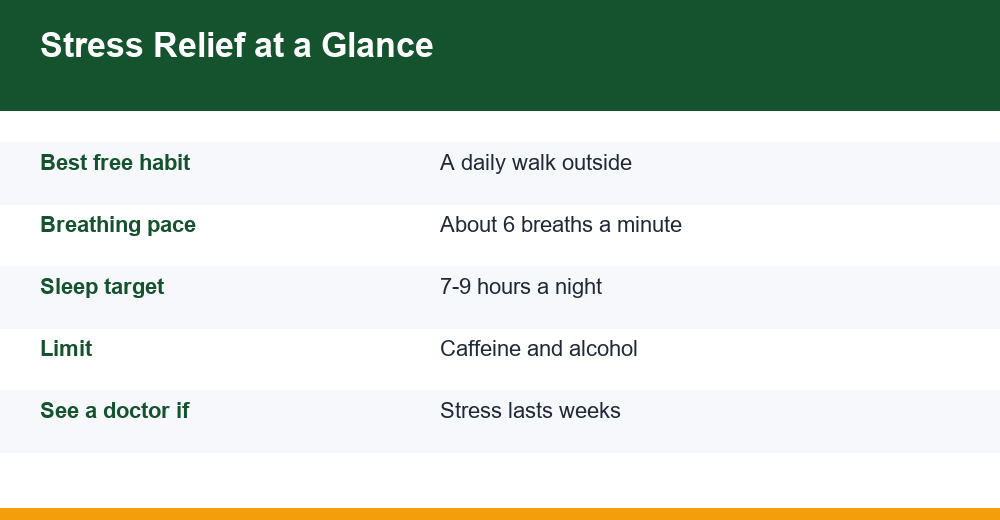
A simple guide is to breathe slowly and make your out-breath longer than your in-breath, settling towards roughly six breaths a minute. Pair it with progressive muscle relaxation — tensing and then releasing each muscle group in turn — to let go of physical tension you may not realise you are holding.
For step-by-step routines you can follow along with, see our guide to breathing exercises for stress. The table below gives a few reliable options to keep in your back pocket.
| Technique | How to do it | Good for |
|---|---|---|
| Slow paced breathing | Aim for about six breaths a minute, with a longer exhale | Everyday calm and winding down |
| Box breathing | Inhale, hold, exhale and hold for a slow, equal count | Feeling wound up or anxious |
| Physiological sigh | Two inhales through the nose, then one long exhale | A quick reset in a tense moment |
| Progressive relaxation | Tense, then release each muscle group in turn | Bedtime and physical tension |
Like anything, breath work rewards practice. A short round once or twice a day, when you are already calm, makes it easier to reach for when stress spikes — your body learns the pattern and drops into it faster. If controlled breathing ever leaves you light-headed, simply return to your normal breath and try again more gently another time.
Sleep, Caffeine and Alcohol
Sleep and stress feed each other. Stress makes it harder to fall and stay asleep, and poor sleep leaves the body primed to overreact, keeping stress hormones elevated the next day. Breaking that cycle by protecting your sleep is one of the highest-value things you can do.
Most adults do best on roughly seven to nine hours. A consistent bedtime, a dark and cool room, and a wind-down that dims screens and lights help far more than willpower. If you lie awake with a racing mind, the slow breathing from the last section is a gentle way back down.
Caffeine and alcohol deserve a closer look. Caffeine is a stimulant that can amplify a jittery, on-edge feeling, especially if you are sensitive to it or drink it late in the day — and its effects vary a lot from person to person. Alcohol may feel relaxing at first, yet it fragments sleep and can leave anxiety worse the following morning.
Food plays a quieter role. Skipping meals can send blood sugar dipping in a way that mimics and magnifies anxiety, so regular, balanced meals with some protein and fibre help keep your mood steadier. Staying hydrated matters more than most people expect, too.
- Keep caffeine to earlier in the day
- Notice whether coffee leaves you wired or calm
- Keep any alcohol within moderate limits
- Swap an evening drink for a calming herbal tea
- Dim screens for an hour before bed
Connection, Boundaries and Journaling
Humans are wired for connection, and a strong support network is one of the best buffers against stress. Talking a problem through with someone you trust can lighten its weight and help you see it from a new angle. You do not always need advice — often you simply need to feel heard.
Just as important is protecting your own capacity. Learning to set boundaries and say no, without long justifications, prevents the slow build-up of resentment and overload that quietly fuels stress. A calendar with a little breathing room in it is itself a stress-management tool.
Writing things down helps too. Journaling — even a few honest lines about what is on your mind, or a short list of things you are grateful for — can take the swirl out of your head and put it on the page, where worries often feel smaller and more manageable.
Be mindful of your inputs, as well. A constant stream of alarming news and comparison-driven scrolling keeps the threat system switched on. Deciding when and how often you check in, rather than reacting to every buzz, hands a little control back to you.
- Reach out to a friend or relative regularly
- Say no to non-essentials without guilt
- Protect short breaks between commitments
- Keep a simple worry or gratitude journal
- Curb late-night scrolling that leaves you tense
Herbal Traditions and Adaptogens
Many cultures have long turned to calming plants as part of an evening ritual, and there is real comfort in the ceremony itself. A warm, unhurried cup of chamomile or lemon balm tea can be a gentle cue that the day is winding down. Aromatherapy has a place here too — many people find the scent of lavender soothing.
So-called adaptogens — herbs such as ashwagandha and rhodiola — have become popular for stress in recent years. Some early human research looks promising, but the evidence is still limited and mixed, dosages are not standardised, and no herb cures or treats a medical condition. It is fairer to see them as a possible supporting act than a fix.
If you are curious, our guide to adaptogens looks honestly at what the research does and does not show. Whatever you try, quality and caution matter more than hype.
Safety is not an afterthought. Herbal supplements can interact with prescription medicines and are not right for everyone. Some, including ashwagandha, are generally advised against in pregnancy and breastfeeding, and certain herbs are not recommended for children or for people with thyroid, liver or autoimmune conditions.
- Check for interactions with any medication
- Avoid in pregnancy or breastfeeding unless advised by a professional
- Take particular care with children, who need professional guidance
- If using essential oils, dilute them in a carrier oil before skin contact and never swallow them
- Choose reputable, clearly labelled products
- Introduce one new thing at a time
- Ask a pharmacist or doctor if you are unsure
Ultimately, herbs are only a small part of how to reduce stress naturally — never a replacement for movement, sleep and human connection, or for professional care when it is needed.
When to Seek Professional Help
Everyday stress usually eases as circumstances shift and you tend to the basics. Sometimes, though, it does not lift — and that is not a personal failing or a lack of willpower. Ongoing or intense stress can tip into anxiety or low mood that deserves proper support.
Consider speaking to a GP or another qualified professional if stress has lasted for weeks, is interfering with your work, relationships or daily life, or comes with panic, hopelessness or thoughts of self-harm. It is also worth seeking help if it has stolen your sleep, if you are leaning on alcohol or other substances to cope, or if you have persistent physical symptoms.
Reaching out early tends to make things easier, not harder. Support might be a conversation with your GP, talking therapies, or simply telling someone close to you how you have been feeling. Treating yourself with the patience you would offer a friend is part of recovery, not separate from it.
Knowing how to reduce stress naturally is genuinely valuable, but it is not a substitute for care when you need it. This article offers general information for healthy adults and is not medical advice; please consult a qualified healthcare professional about your own health, symptoms or medicines. If you ever feel unsafe or in crisis, seek urgent help straight away.
Frequently Asked Questions
What is the fastest way to reduce stress naturally?
For quick relief, slow your breathing — a longer exhale than inhale for a minute or two — or take a brisk walk outside. These calm your nervous system almost immediately. For lasting change, though, how to reduce stress naturally comes down to consistent sleep, movement and connection.
Do herbal teas and adaptogens actually lower stress?
Some people find rituals like chamomile tea calming, and early research on adaptogens such as ashwagandha looks promising. But the evidence is still limited, no herb cures stress, and supplements can interact with medicines — so treat them as an optional extra and check with a pharmacist first.
How does sleep affect my stress levels?
Sleep and stress influence each other. Poor sleep keeps stress hormones raised and makes you more reactive, while stress makes restful sleep harder to reach. Protecting seven to nine hours with a steady routine is one of the most effective natural ways to steady your mood.
When should I see a doctor about stress?
Speak to a GP if stress has lasted weeks, disrupts your work, sleep or relationships, or comes with panic, low mood or thoughts of self-harm. If you rely on alcohol to cope or feel unable to manage, professional support can help — this is not a personal failing.