Breathing exercises for stress are one of the simplest, most portable tools you have for calming a racing mind and a tense body. You already breathe all day without thinking about it, yet a few minutes of slow, deliberate breathing can quietly shift you out of fight-or-flight and into a steadier, calmer state. This guide walks through seven gentle techniques, how to do each one, and when to reach for them.
Table of Contents
How Breathing Exercises for Stress Calm the Body
When you feel stressed, your breathing usually becomes faster, shallower and higher in the chest. This is part of the body’s built-in alarm response, and it keeps your nervous system primed for action. Deliberately slowing the breath sends the opposite message, gently reassuring your body that the threat has passed and it is safe to settle.
Breathing is unusual among the body’s automatic functions: it happens on its own, yet you can also take conscious control of it whenever you choose. That makes it a rare, direct handle on the nervous system. By changing how you breathe, you can nudge how you feel, often within a minute or two.
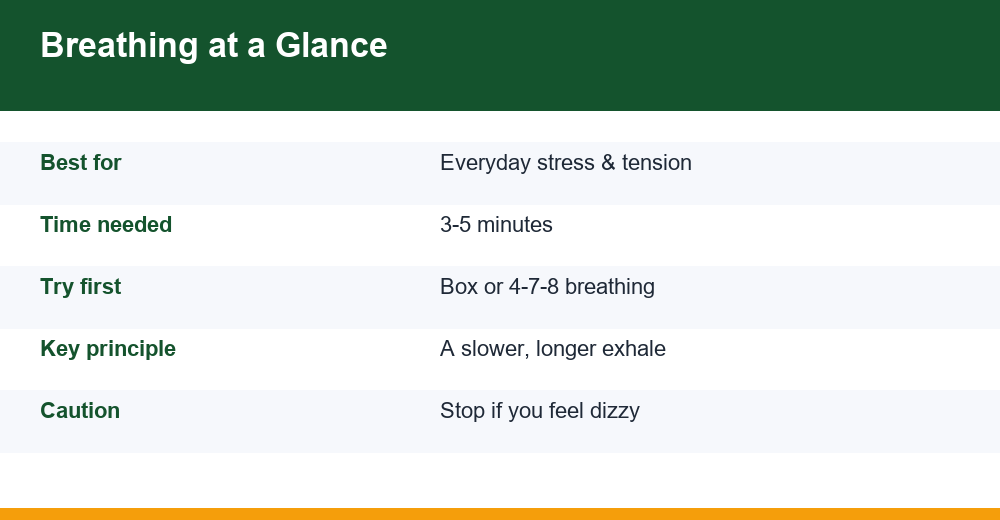
The real power is mostly in the exhale. A long, slow out-breath helps switch on the parasympathetic nervous system, the ‘rest and digest’ branch that lowers your heart rate and loosens tense muscles. That is why most calming methods make the out-breath longer than the in-breath, or add a soft pause between the two.
There is also a simple feedback loop at play. Fast, shallow breathing can leave you feeling more on edge, which in turn tends to speed the breath up further. Gently interrupting that cycle, even for a few breaths, sends your mind a small, steadying signal that you are safe and can begin to ease.
It helps to stay honest about what this can and cannot do. Breathing exercises for stress are a supportive lifestyle practice, not a cure for anxiety disorders or any medical condition. Research suggests slow breathing can ease feelings of stress and tension in the moment, although study quality varies and results differ from one person to the next.
They also work best as part of a bigger picture. If you are putting together a wider toolkit, our guide on how to reduce stress naturally covers the sleep, movement and daily rhythms that make these techniques far more effective.
Getting the Basics Right First
Before trying any specific method, a few basics make every breath count. Find a comfortable position: sit with both feet flat on the floor, or lie down with your arms resting a little away from your sides. Let your shoulders drop, unclench your jaw, and soften your face so nothing is holding tension.
- Breathe low and slow, aiming to feel your belly rise more than your chest.
- Breathe in through your nose where you can, so the air is warmed and filtered.
- Stay gentle; never force an in-breath or strain to hold one.
- Begin with three to five minutes, then build up as it starts to feel natural.
The UK’s NHS breathing exercise for stress recommends practising for at least five minutes and returning to it regularly, rather than only reaching for it in a crisis. That consistency is what teaches your body to settle more quickly over time.
7 Simple Breathing Techniques to Try
Here are seven of the most useful breathing exercises for stress, ranging from beginner-friendly counts to gentle, yoga-inspired methods. Try a handful and keep the ones that feel natural. There is no single ‘best’ option, only the technique you will actually reach for when you need it.
1. Box breathing
Box breathing uses four equal counts, like tracing the four sides of a square. It is a favourite of athletes and emergency responders because it is easy to remember when your mind is racing.
- Breathe in through your nose for a count of four.
- Hold the breath gently for four.
- Breathe out through your mouth for four.
- Hold for four, then begin the next round.
Best for steadying your focus just before a stressful moment, and handy any time you notice your breath has gone shallow at your desk. If holding feels uncomfortable, shorten the count or drop the holds altogether.
2. The 4-7-8 breath
Popularised by Dr Andrew Weil, this method stretches the exhale far longer than the inhale, which many people find deeply relaxing before sleep.
- Breathe in quietly through your nose for a count of four.
- Hold your breath for a count of seven.
- Breathe out slowly through your mouth for a count of eight.
- Repeat for up to four cycles when you are starting out.
The long hold can feel intense at first, so keep the rounds few. The formal evidence is still limited and based on small studies, but the extended out-breath fits what we understand about slowing the heart.
3. Diaphragmatic (belly) breathing
Belly breathing is the foundation beneath every other technique. It teaches you to lead with the diaphragm, the dome-shaped muscle under your ribs, instead of breathing shallowly into the chest.
- Rest one hand on your chest and the other on your belly.
- Breathe in slowly through your nose so the lower hand rises first.
- Keep the upper hand relatively still as the belly expands.
- Breathe out slowly and feel the belly gently fall.
Practise for a few minutes a day until the pattern feels automatic, then use it as the base for all the others.
4. Coherent breathing
Coherent or resonance breathing simply means slowing to around five or six breaths a minute. At this pace, heart rate and breath tend to fall into step, which research links to higher heart rate variability, a sign of a flexible, resilient nervous system.
- Breathe in gently for a count of about five or six.
- Breathe out for the same count, with no pause in between.
- Keep it smooth and continue for five to ten minutes.
This is a lovely everyday practice for building calm over time, rather than a quick rescue in a panic. Aim for the same relaxed pace most days and let it become a small ritual.
5. Alternate-nostril breathing (Nadi Shodhana)
A traditional yoga practice, alternate-nostril breathing uses the fingers to breathe through one nostril at a time. Many people find the rhythm quietly centring and focusing.
- Use your right thumb to close your right nostril and breathe in through the left.
- Close the left nostril with a finger and breathe out through the right.
- Breathe in through the right, then switch and breathe out through the left.
- Continue for a few minutes, keeping each breath soft and even.
Skip it while your nose is congested, and avoid any breath-holding versions if you are pregnant or have high blood pressure.
6. Pursed-lip breathing
This straightforward method naturally slows your exhale and is often taught to ease breathlessness. It is useful when stress leaves you feeling like you cannot get a full breath.
- Breathe in through your nose for about two counts.
- Purse your lips as if you were gently blowing out a candle.
- Breathe out slowly through those pursed lips for about four counts.
Let the out-breath stay relaxed and unhurried; there is no need to empty the lungs forcefully.
7. Extended-exhale breathing
If counting feels fiddly, simply make each out-breath a little longer than each in-breath. Some people add a quick ‘double inhale’ through the nose followed by one long sigh out, which can release built-up tension surprisingly fast.
- Breathe in for a count of about three or four.
- Breathe out slowly for a count of five or six.
- Repeat for a minute or two whenever you feel tension climbing.
Notice how most of these share one theme: a slower, longer exhale. Once that idea sinks in, you can improvise your own version almost anywhere, even without counting, by simply letting each out-breath trail a little longer than the one before it.
Choosing the Right Technique for the Moment
Different moments call for different breaths. Use this quick guide to match a technique to how you are feeling, then adjust the counts to suit your own comfortable rhythm rather than chasing exact numbers.
| Situation | Try this | Roughly how long |
|---|---|---|
| Sudden stress or worry | Extended-exhale or 4-7-8 | 1-3 minutes |
| Before a meeting or exam | Box breathing | 2-4 minutes |
| Winding down for sleep | 4-7-8 breathing | A few gentle cycles |
| Everyday calm and resilience | Coherent breathing | 5-10 minutes |
| Feeling scattered or foggy | Alternate-nostril | 3-5 minutes |
| Short of breath | Pursed-lip breathing | 1-2 minutes |
None of these needs any equipment, and you can trim any of them to a single minute when time is short. The best technique is always the one you will actually remember to use.
Common Mistakes to Avoid
A few small habits can quietly undo the benefit of an otherwise good practice. None of them is serious, and each is easy to adjust once you notice it. If a technique never seems to help, it is often one of these getting in the way, rather than the method itself.
- Breathing too deeply or too quickly, which can leave you lightheaded rather than calm; aim for slow and comfortable, not big and forceful.
- Forcing the breath or straining to hit exact counts, when the numbers are only a guide you can loosen until the rhythm feels easy.
- Tensing the shoulders and chest instead of letting the belly lead the movement.
- Only reaching for it in a crisis, when the effect is far stronger if you have also rehearsed on calm days.
- Giving up after a single try, since the calming benefit tends to grow over a week or two of short, regular sessions.
If you catch yourself doing any of these, simply pause, soften your shoulders, and begin again more gently. Being patient with yourself is part of the practice, not a separate task.
Safety, Cautions, and When to Get Help
Slow breathing is safe for most people, but a few sensible cautions apply. If you feel dizzy, lightheaded or somehow more anxious, stop and let your breathing drift back to its natural pace. These effects are harmless and usually pass within a moment or two.
- Avoid long breath-holds if you are pregnant, or have high or low blood pressure, unless a professional has said it is fine.
- Be cautious with fast or forceful breathing styles, which are very different from these gentle techniques and can cause dizziness.
- If you have asthma or a heart or lung condition, keep the breath gentle and check with your clinician first.
- Never practise while driving, and never in or near water.
Children and teenagers can enjoy gentle breathing too, but keep it playful, short and free of long breath-holds, and let a child stop the moment they want to.
Most importantly, breathing exercises for stress are general wellbeing support, not a substitute for medical care. They will not treat or cure serious conditions such as panic disorder, depression or a heart problem. If stress feels overwhelming, or you have persistent physical symptoms, please talk with a doctor or another qualified professional. This article is general information, not medical advice.
Building a Daily Practice
The real benefit of breathing exercises for stress comes from repetition. Like any skill, calm breathing becomes easier the more you do it, so your body learns to find that steadier gear more quickly on the days you truly need it.
- Anchor your practice to something you already do, such as your morning coffee or getting into bed.
- Keep sessions short and genuinely pleasant, rather than long and dutiful.
- Pair the breath with a quiet pause or a few minutes of stillness.
If you would like to go a step further, breathing sits naturally alongside stillness. Our gentle meditation for beginners guide is an easy next step once these techniques start to feel familiar.
It can also help to notice, without judgement, how you feel before and after each session. Even a rough sense of being ‘a little calmer’ is useful feedback, and over a few weeks those small shifts are what build a steadier baseline you can lean on.
Above all, be patient with yourself. Some days the breath will settle you within seconds; other days it will only take the edge off, and even that is well worth the few minutes it takes.
Frequently Asked Questions
How long should I practise these breathing techniques?
Most people notice a shift within three to five minutes, so that makes a good starting point, though even a single minute can help in a pinch. For lasting benefits, aim for a short daily session rather than one long practice, and build up gradually as it begins to feel natural.
Which breathing technique is best for anxiety at night?
Many people find the 4-7-8 breath and coherent breathing especially settling before sleep, because both lengthen the exhale and gently slow the heart rate. Keep the room dark, breathe softly through your nose, and stop if any count starts to feel like a strain rather than a relief.
Can breathing exercises replace medication or therapy?
No. These are supportive lifestyle practices, not a treatment or cure for any condition. They can sit alongside professional care, but should never replace it. If you take medication or live with a diagnosed condition, keep following your clinician’s advice, and mention any new breathing practice you try.
Is it normal to feel dizzy when I slow my breathing?
A little lightheadedness can happen, usually from breathing too deeply or holding the breath too long. It is harmless, but it is a signal to ease off: return to your natural rhythm, shorten the counts and skip the holds. If dizziness keeps returning, check in with a health professional.