If the idea of sitting still feels intimidating, this guide to meditation for beginners is here to make starting feel simple, doable, and kind. Meditation isn’t about emptying your mind or reaching some perfect state of calm; it’s a gentle practice of paying attention, one breath at a time. Wherever you’re starting from, a few quiet minutes a day is more than enough to begin.
Table of Contents
What Meditation Really Is (and Isn’t)
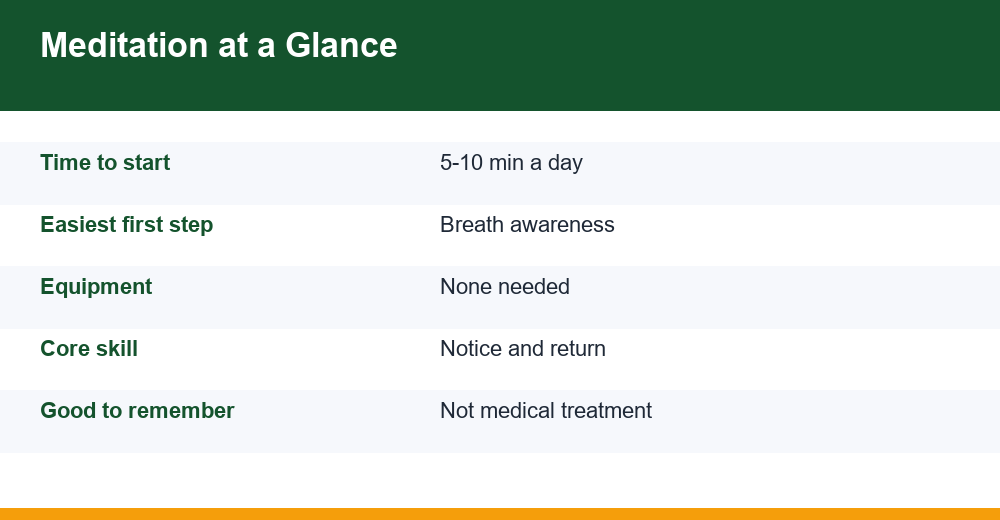
At its simplest, meditation is the practice of gently placing your attention somewhere — your breath, your body, a sound — and noticing when it wanders off. That’s it. The skill you’re building isn’t a blank, silent mind; it’s the quiet habit of noticing and returning, over and over, without giving yourself a hard time about it.
This matters because much of the pressure people feel when they start comes from a single myth: that they should be able to switch their thoughts off. You can’t, and you’re not meant to. Thoughts keep arriving like passing traffic. Meditation simply changes how you relate to them — you learn to watch them go by instead of chasing each one down the road.
One of the kindest things to understand about meditation for beginners is that a wandering session still counts. If your mind drifted a hundred times and you brought it back a hundred times, that’s a hundred small reps of exactly the skill you came to practise. There is no such thing as a failed sit.
You’ll often hear meditation and mindfulness used together. A simple way to hold the difference: mindfulness is the quality of open, present attention, while meditation is the set-aside time you spend deliberately training it. Once you’ve practised in a quiet moment, that same attention becomes easier to carry into ordinary parts of your day.
- Myth: you must clear your mind. Reality: you’re learning to notice thoughts, not delete them.
- Myth: it has to be religious. Reality: it can be entirely secular, or sit comfortably alongside any faith.
- Myth: you should feel instantly calm. Reality: some sessions feel restless, and that is completely normal.
- Myth: you need an hour. Reality: a few honest minutes is a real, worthwhile practice.
Why People Try Meditation
Most people arrive looking for a little more calm — a pause between feeling something and reacting to it. A regular practice is often described as supporting everyday wellbeing: steadier focus, a gentler relationship with stress, and, for some, easier sleep. Many simply find it a pleasant way to reset in the middle of a demanding day.
People who keep the habit going often mention a handful of small, everyday shifts:
- A slightly longer pause before reacting to stress
- Steadier focus on one task at a time
- A kinder, less critical inner tone
- Winding down a little more easily at the end of the day
It helps to be honest about what meditation can and can’t do. It is widely explored as part of general wellbeing programmes, and many people say they feel calmer or more able to cope. That isn’t the same as a cure. It’s best thought of as a supportive lifestyle habit that may change how you relate to your experience — not a treatment for any medical condition, and not a substitute for professional care.
If you’d like a trustworthy starting point, the NHS Every Mind Matters guide walks through the basics in plain language. If you’re managing a health condition, treat these ideas as general encouragement and check in with a professional who knows your situation.
Types of Meditation for Beginners to Try
There is no single correct technique, and the best one is usually whichever you’ll actually do. Below are the styles most people begin with, and what each tends to be good for. It’s fine to sample a few over a couple of weeks before settling on a favourite.
| Practice | What you do | Nice for |
|---|---|---|
| Breath awareness | Follow the natural in-and-out of your breath, returning whenever you drift | A simple, portable focus |
| Body scan | Move attention slowly from head to toe, noticing sensations without fixing them | Releasing tension, winding down |
| Guided meditation | Follow a recorded voice or app that talks you through each step | Total beginners |
| Mindfulness | Bring open attention to ordinary moments such as eating or walking | Fitting practice into a busy day |
| Loving-kindness | Silently wish wellbeing to yourself and then to others | Easing self-criticism |
If focusing on the breath appeals to you, gentle breathing exercises for stress can be an easy on-ramp — they use the same anchor and take only a minute or two, so they slot neatly into a work break or a tense moment.
A body scan is especially popular in the evening. Moving attention slowly through the body, resting briefly on each area, can help you let go of the day’s tension and settle a restless mind before sleep. Guided recordings are ideal here, because you can simply listen and follow rather than remembering what comes next.
Posture, Setting, and How Long to Sit
You don’t need any special equipment — just somewhere reasonably quiet and warm where you can sit for a few minutes without being disturbed. A chair is perfectly fine; so is the floor with a cushion if that feels comfortable. The aim is a posture you can hold with ease, not one that looks a certain way.
- Sit so you feel upright but relaxed — imagine a gentle string lifting the crown of your head.
- Let your shoulders drop, and rest your hands on your thighs or in your lap.
- Close your eyes, or soften your gaze down toward the floor if closed eyes feel uneasy.
- Keep your feet flat if you’re on a chair; there’s no need to force a cross-legged pose.
How long should you sit? Shorter and regular beats long and occasional. A realistic goal for meditation for beginners is five to ten minutes a day, then extending only when it feels inviting rather than like a chore. Ten focused minutes you keep up will always outperform an ambitious hour you dread and skip.
There’s no perfect time of day, either. Morning can set a calmer tone before things get busy; evening can help you unwind and ease into sleep. The best slot is simply the one you’ll actually return to.
It also helps to remove small points of friction in advance. Silence your phone or switch it to do-not-disturb, let anyone nearby know you’ll be a few minutes, and have your cushion or chair ready to go. The easier a practice is to start, the more likely you are to keep it.
Your First Five-Minute Meditation
Ready to try? Here’s a short, beginner-friendly practice you can do right now. Read it through once so you have the shape of it, then give it a go. Five minutes is plenty; set a soft timer if that helps you relax and stop clock-watching.
- Sit comfortably and let your eyes close, or lower your gaze. Take one slow, slightly deeper breath to arrive.
- Let your breathing settle into its own natural rhythm. Don’t control it — just feel it happening.
- Rest your attention on wherever you notice the breath most clearly: the nose, the chest, or the belly.
- When you realise your mind has wandered (it will), gently escort your attention back to the breath.
- After a few minutes, take one more slow breath, notice how you feel, and open your eyes.
That’s a complete meditation. If it felt clumsy, dull, or busy, you didn’t do it wrong — noticing and returning is the practice, not a sign you failed at it. Every wander you catch is the exercise working exactly as intended.
What to Do With a Busy Mind
Here’s the reassuring truth: a busy mind is not a sign you’re doing it wrong. In many ways it’s the whole point. Every time you notice you’ve drifted and come back, you’re strengthening attention — a little like a gentle rep at the gym. A loud, distracted session can be one of the most useful you’ll have.
- Notice you’ve wandered. This noticing is the moment of mindfulness itself.
- Let go of the storyline, without scolding yourself for having drifted.
- Gently return to your anchor — the breath, a sound, or a point in the body.
- Repeat as many times as needed. There is no quota, and there is no failing.
If your mind is especially loud, it can help to quietly name what’s happening — a soft ‘thinking’ or ‘planning’ — and then come back. Counting breaths up to ten and starting again is another steadying anchor when thoughts feel relentless.
You can also carry this attention off the cushion. Everyday mindfulness practices — really tasting your morning coffee, feeling your feet as you walk — build the very same muscle in the middle of ordinary life, and they ask for no extra time in your day.
How to Build a Habit That Lasts
Motivation fades; habits stick. The trick with meditation for beginners is to make the practice so small and so anchored to your day that skipping it feels stranger than simply doing it. Aim to be consistent first and impressive later.
- Attach it to something you already do — after brushing your teeth, or before your first coffee.
- Start absurdly small. One or two minutes counts, and it removes the ‘no time’ excuse.
- Keep a cue visible — a cushion left out, or the app on your home screen.
- Aim for most days, not every day. Missing one is normal; two in a row is worth a gentle nudge.
- Track it lightly if that motivates you — a simple tick on a calendar can be surprisingly satisfying.
Expect the experience to vary. Some days feel spacious and easy; others feel fidgety and flat. Both are normal, and neither is a verdict on your progress. Consistency across weeks matters far more than how any single session happened to feel.
Guided apps and free recordings can carry you through the early weeks, when unstructured silence tends to feel hardest. Lean on them for as long as they help — there’s no prize for going it alone.
Safety, Cautions, and When to Get Support
For most people, meditation is a gentle, low-risk practice. Even so, it isn’t automatically right for everyone at every moment, and it’s honest to say so — something many beginner guides quietly skip over.
Meditation can occasionally stir up difficult emotions or memories, and very long or intense sessions have left some people feeling dizzy, spaced out, or detached from their surroundings. If you live with trauma, PTSD, severe anxiety, depression, or a history of psychosis, it’s wise to approach carefully — ideally with a trauma-informed teacher or with input from your clinician.
- Keep early sessions short, and stop if you feel significantly worse rather than pushing through.
- Favour guided, gentle practices over long, unstructured silence while you’re new.
- If a particular technique reliably increases distress, it’s fine to pause or switch to another style.
- Treat meditation as a complement to, never a substitute for, mental-health treatment.
None of this is meant to put you off. For most people, a few gentle minutes a day is safe and rewarding. The point is simply to start small, stay curious about how each session leaves you feeling, and give yourself full permission to adjust.
This article is general information about a wellbeing practice, not medical advice. If you’re managing a health condition, persistent low mood, or any serious or worsening symptoms, please speak with a qualified healthcare professional who can offer guidance for your particular situation.
Frequently Asked Questions
How long until meditation actually works?
Many people notice small shifts — a little more calm, or a touch more perspective — within a couple of weeks of near-daily practice, though this varies widely. Benefits tend to build gradually, so treat it like tending a garden rather than flipping a switch.
Is meditation for beginners actually worth trying?
For most people it’s a worthwhile, low-cost experiment. You need no equipment and only a few minutes a day. Give it a fair trial of a few weeks, and judge it by how you feel across your days, not by how any single session happened to go.
What time of day is best to meditate?
There’s no universally best time — the best slot is the one you’ll actually keep. Morning can set a calm tone for the day, while an evening body scan can help you unwind before sleep. Consistency matters far more than the exact hour on the clock.
Do I need an app or a teacher to start?
Not necessarily, but they help. Guided apps and free recordings are especially useful in the early weeks, when silence feels hard. A qualified teacher can be valuable if you have mental-health concerns, or simply want personal guidance and a little encouragement.