Everyday mindfulness practices are simply ways of paying attention to the present moment on purpose, without judging what you find. You do not need incense, an hour of silence, or a special cushion to begin — just a minute and a little willingness. This guide walks through nine simple, secular approaches that fit around real life, plus an honest look at what they can and cannot do.
Table of Contents
What Mindfulness Really Means
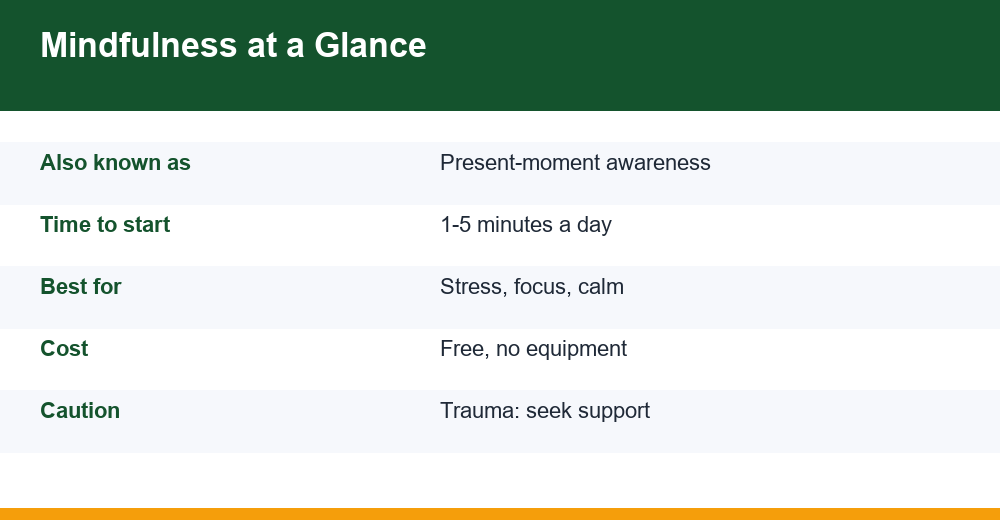
At its core, mindfulness means noticing what is happening right now — your breath, your body, the food on your fork, the sound of rain outside — instead of moving through the day on autopilot. It is a skill rather than a belief system, something you build slowly with practice. Anyone can do it, whatever their background, beliefs or religion, and you can begin in the next sixty seconds without any special equipment.
Modern, secular mindfulness grew largely out of clinical programmes such as Mindfulness-Based Stress Reduction, developed in the late 1970s and later adapted for anxiety, low mood and chronic pain. Today it appears in schools, workplaces and healthcare settings. The aim is not to empty your mind or force yourself to feel calm on command, but to observe your experience with a little more curiosity and a little less automatic reaction.
You might wonder why something so simple would help. Part of the answer is that much of our stress comes not from events themselves but from the mental commentary around them — replaying the past, rehearsing the future, judging ourselves. Returning attention to the present, even briefly, interrupts that loop and gives the nervous system a chance to settle.
There are broadly two ways to practise. Formal practice means setting aside a few dedicated minutes to sit, breathe or scan the body. Informal practice means bringing the same quality of attention to things you already do — eating, walking, washing up, listening to a friend. Neither is better than the other. Beginners often find informal moments easier to sustain, while a little formal practice can sharpen the attention you then carry into everyday life.
It helps to be clear about what this practice is and is not before you start:
- It is gently returning your attention to the present, again and again.
- It is not clearing your mind, stopping thoughts, or feeling blissful on demand.
- It is a practical skill that steadily improves with repetition.
- It is not a substitute for medical or psychological treatment.
The Realistic Benefits of Mindfulness
Research in this field has grown quickly over the past two decades, and the honest picture is encouraging but measured. Reviews suggest that structured mindfulness training can produce small-to-moderate improvements in stress, anxiety and low mood for many people. Those effects are genuine and worthwhile, but they are not miraculous, and they vary from person to person.
According to the UK’s NHS guidance on mindfulness, paying attention to the present moment can help you notice unhelpful thought patterns and feel better able to manage them. Some studies also point to modest benefits for sleep and for coping with ongoing stress, though results are mixed, and the strongest evidence tends to come from longer, formal courses rather than one-off exercises.
It also helps to know what ‘small-to-moderate’ can feel like in daily life. For most people it is not a dramatic transformation but a gentler baseline — noticing irritation a beat sooner, recovering from a stressful message a little faster, settling into sleep with a touch less effort. Some people feel very little, and that is normal too. Mindfulness suits some temperaments and some seasons of life better than others.
It is worth staying cautious with bold claims. These mindfulness practices are best seen as one supportive habit among many — alongside sleep, movement, connection and, where needed, professional care. They do not cure depression, anxiety disorders or physical illness, and they are not a shortcut around life’s genuine difficulties.
Results also depend on how you approach it. People who treat it as a regular, low-pressure habit tend to notice more than those chasing a quick fix or a particular feeling. Expecting instant bliss can make ordinary practice feel disappointing; approached with patience, small shifts in mood and focus often build quietly over weeks.
With regular practice, people often report:
- Feeling less swept up in worry and rumination
- A calmer, less reactive response to everyday stress and irritation
- Greater awareness of hunger, tension and mood
- More small moments of enjoyment and gratitude
9 Simple Mindfulness Practices to Start Today
You can practise awareness in the middle of an ordinary day, with no extra time required. Pick one or two ideas below and try them for a week before adding more. The table gives a quick overview, and the notes underneath add detail.
| Practice | Time needed | What to focus on |
|---|---|---|
| Mindful breathing | 1-3 min | The feel of each in-breath and out-breath |
| Mindful eating | One meal | Colour, texture, taste, hunger cues |
| Mindful walking | 5-10 min | Feet, breath, sights and sounds |
| Single-tasking | Any task | One thing at a time, fully |
| Body scan | 3-10 min | Sensations from head to toe |
| Gratitude pause | 1-2 min | Three specific good things |
| Mindful listening | One chat | The speaker, not your reply |
| The STOP pause | 30 sec | Stop, breathe, observe, proceed |
| Mindful chores | While doing them | Warm water, movement, sound |
Rather than memorising all nine, it can help to group them. The four short sections below cluster the ideas by theme so you can see how they fit together in an ordinary day.
Not sure where to begin? Choose by the moment that tends to feel most rushed. If mornings are frantic, start there with three slow breaths before you reach for your phone. If meals are eaten at your desk, try one mindful lunch. If evenings spin with worry, a short body scan or gratitude pause can help you land. Matching a practice to a real pinch point makes it far more likely to stick.
Anchor yourself with the breath
Your breath is always with you, which makes it the simplest anchor of all. Sit or stand comfortably and follow ten slow breaths, feeling the air move in and out. When your mind wanders — and it will, many times — simply notice and come back without frustration. A quick ‘STOP’ pause uses the same idea in miniature: Stop, take a Breath, Observe how you feel, then Proceed. For more techniques, see our guide to breathing exercises for stress.
Eat, walk and move with awareness
Mindful eating means slowing down for at least the first few bites of a meal: notice the smell, texture and flavour, and check whether you are genuinely hungry. It can curb mindless snacking and make food more enjoyable. Mindful walking turns a commute or short stroll into practice — feel your feet meet the ground and let your senses take in the surroundings. Even routine chores like washing up become anchors when you focus on the warm water and steady movement.
Give one thing your full focus
Most of us switch constantly between tasks, tabs and screens, which fragments attention and quietly raises stress. Single-tasking is the gentle antidote: close the extra windows, silence notifications and give one job your whole focus until it is done. Mindful listening applies the same principle to people — really hearing someone instead of rehearsing your reply. Both can feel slower at first, yet they usually lead to better work, fewer mistakes and calmer conversations.
Notice the body, and say thanks
A short body scan — travelling in your mind from head to toe, noticing tension or comfort without trying to change anything — builds body awareness and can ease physical stress. A daily gratitude pause, where you name three specific things that went well, gently steers your attention toward what is good rather than only what went wrong. Neither takes more than a couple of minutes, and both slot easily into a morning or bedtime routine.
Beyond Meditation: Weaving Awareness Into Daily Life
Formal sitting meditation is valuable, but it is only one doorway. If sitting still feels hard, you are not alone — and the good news is that everyday awareness genuinely counts. That said, a short daily sit can deepen everything else and is easier to learn than most people expect; our meditation for beginners guide walks you through the first steps.
Think of it as two lanes that support each other. A few minutes of quiet practice builds the ‘muscle’ of attention; informal mindfulness practices then apply that muscle while you eat, walk, work and talk. Neither lane is better than the other — the most useful routine is simply the one you will actually keep.
Many people find a natural rhythm: a short seated practice in the morning to set the tone, then informal awareness scattered through the day as reminders. Others skip formal sitting entirely and rely on everyday anchors. Both are legitimate. What matters is that the practice fits your life rather than becoming one more thing to feel guilty about.
A Gentle Plan for Your First Week
You do not need to try all nine ideas at once. A light, forgiving plan makes it far more likely the habit will actually stick. Here is one relaxed way to spread them across seven days.
- Days 1-2: one minute of mindful breathing shortly after you wake.
- Day 3: eat one meal slowly, noticing the first few bites.
- Day 4: take a five-minute mindful walk, phone in your pocket.
- Day 5: single-task one piece of work with notifications off.
- Day 6: try a short body scan before sleep.
- Day 7: end the day by naming three things you are grateful for.
Notice which of these felt easiest and most natural, and let those become your foundation. There is no prize for doing all of them; two or three you genuinely enjoy will serve you far better than nine you resent.
How to Build a Habit That Lasts
The biggest mistake with new mindfulness practices is starting too big. Five reliable minutes will always beat an ambitious plan you abandon by Wednesday, so make the first version almost laughably small.
- Anchor it to something you already do, such as your first cup of tea.
- Begin with two or three minutes and let it grow naturally.
- Expect your mind to wander — returning your focus is the practice.
- Use a timer or simple app if it helps, but keep the phone on silent.
- Be kind to yourself on the days you forget, and just begin again.
It also helps to make the practice pleasant rather than another chore on a to-do list. Pair it with something you like — a favourite chair, a warm drink, a view from a window — so your brain associates the habit with comfort. Track it lightly if that motivates you, but avoid turning a calming practice into a source of pressure.
Consistency matters more than duration. A brief daily habit tends to outperform a long weekly session, and over time it quietly changes how you meet stress across the whole day.
Missing a day, or even a whole week, is not failure — it is simply part of the process. The habit is not a chain you must never break; it is a doorway you can walk back through any time. When you notice you have drifted, resist the urge to make up for lost ground with one heroic session. Just return to your small, ordinary version the next morning, without commentary. The willingness to begin again is itself the practice.
Common Myths That Hold People Back
A few myths stop people from trying mindfulness practices at all. Clearing them up makes starting far easier.
- “I have to clear my mind.” You don’t — noticing thoughts and letting them pass is the whole point.
- “I’m too busy.” Everyday tasks like washing up or walking can become practice, with no extra time.
- “My mind wanders, so I’m bad at it.” Wandering is normal; each gentle return strengthens attention.
- “It has to be a long session.” A minute done often beats an hour you never quite get to.
- “It’s religious.” Secular mindfulness has no spiritual requirement and fits any worldview.
Safety, Cautions, and When to Get Support
For most people, gentle mindfulness is low-risk. Even so, it is not automatically right for everyone, and honesty matters more than hype.
- Trauma and PTSD: turning attention inward can sometimes surface distressing memories, so consider working with a trauma-informed therapist rather than practising intensively alone.
- Existing mental health conditions: mindfulness may complement treatment but should not replace therapy or prescribed medication — check with your clinician first.
- Pregnancy and children: gentle awareness and breathing are usually fine, but keep sessions short, comfortable and free of pressure for children.
- Discomfort is information: if a practice consistently increases anxiety or distress, stop and seek guidance.
If you would like more structure, look for evidence-based courses such as MBSR or MBCT, ideally taught by a trained instructor, or reputable apps and free resources from health services. Be a little wary of any programme promising rapid cures or dramatic change. A group course can add helpful accountability and a sense of shared effort. Whatever route you choose, keep checking that the practice leaves you feeling steadier rather than pressured — that feedback matters more than any single technique.
This article offers general information about lifestyle practices, not medical advice. Mindfulness is a supportive habit, not a treatment or cure for any condition. If you are struggling with your mental or physical health, or you notice persistent or severe symptoms, please speak with a qualified healthcare professional.
Frequently Asked Questions
What are mindfulness practices in simple terms?
They are simple ways of paying full attention to the present moment — your breath, food, movement or surroundings — without judging it. They can be formal, like meditation, or informal, woven into everyday tasks. The goal is steadier attention and a calmer response to stress, not a blank mind.
How long should I practise each day?
Start small — even one to five minutes a day is enough to build the habit. Consistency matters far more than length, so a short daily practice usually beats a long weekly one. As it starts to feel natural, you can gradually extend the time you spend.
Can mindfulness replace therapy or medication?
No. Mindfulness is a supportive lifestyle habit, not a treatment or cure for any condition. It can sit alongside professional care, but it should never replace therapy or prescribed medication. If you are struggling, speak with a qualified healthcare professional before changing your treatment.
Is mindfulness safe for everyone?
For most people it is low-risk, but it is not right for everyone. Those with a history of trauma or PTSD may find inward attention distressing and should seek a trauma-informed professional. If any practice consistently increases anxiety or distress, stop and ask for guidance.