A gambling habit rarely begins with a big decision. More often it starts with a few quick rounds on a phone during a tired evening. Because colour-prediction games settle in seconds, they can slip past the mind’s natural pauses and turn a moment of curiosity into a routine that drains money, sleep and calm. This guide explains why that happens, the warning signs to watch for, and where people in India can find free, confidential help.
Table of Contents
Why Fast-Round Colour Games Hook the Mind
Fast-round money games quietly break the healthy rhythm of rest, movement, food and connection. They are built around short cycles of anticipation and result, repeated again and again, with almost no natural stopping point. None of the mechanisms below requires a person to be weak or foolish. They work on ordinary human brains, which is exactly why they deserve respect.
Variable rewards
When a win arrives unpredictably, the brain’s reward system becomes more alert, not less. This is called a variable reward schedule. You never know whether the next round will pay, so the urge to try once more stays strong.
Near misses
Picking green when the result is red can feel like you were close, even though every outcome was equally random. Near misses create a sense of almost-skill, which encourages another attempt rather than a pause.
Chasing losses
After a loss, many people feel a strong pull to win the money back quickly. This is known as chasing losses, and it is one of the clearest routes from casual play into harm. Each new stake is placed to repair the last one, so the hole tends to deepen.
What These Apps Are and the Real Money Risk
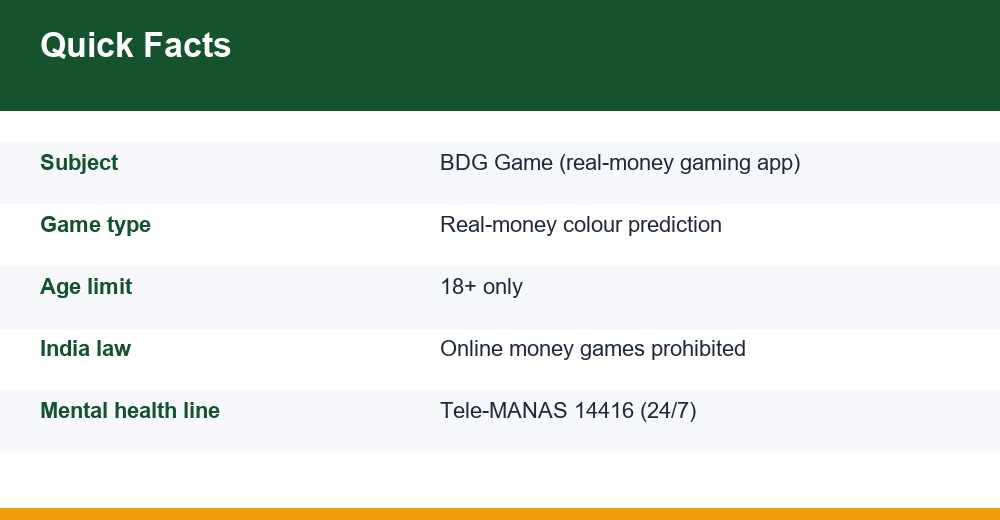
BDG Game, sometimes referred to online as Big Daddy Game, is one of several real-money apps promoted to players in India. Its best-known feature is colour prediction, where users stake money on whether the next result will be a particular colour or number. This article is an informational explainer, not a recommendation. We do not encourage anyone to download such an app, deposit money or play, and anyone using these platforms must be 18 or older.
The key fact is mathematical. Outcomes are determined by chance, and the operator builds in a margin for itself, often called a house edge. That means the expected value is negative: over many rounds, the average player loses money. No pattern, prediction tip or so-called winning trick can change that.
An illustrative example (the numbers are invented, not taken from any app) shows how this works in practice. Imagine a game where a correct guess pays slightly less than fair odds, so the operator keeps about five paise of every rupee staked over time. Someone who stakes ₹100 a round for 200 rounds a week has put ₹20,000 through the game, and the expected loss is roughly ₹1,000, even though individual evenings may end ahead. The small wins feel memorable; the slow, steady drain is easy to overlook.
| Common thought | What is actually true |
|---|---|
| “I have spotted a pattern in the colours.” | Results are random; past rounds do not predict the next one. |
| “I was so close last time.” | A near miss is still a loss and says nothing about future rounds. |
| “One more win and I will be even.” | Chasing losses usually increases total losses. |
| “I can treat this as side income.” | With a built-in house edge, it is a cost, not an income. |
We do not claim this platform is a scam. Still, pressure to deposit more, referral schemes and delayed withdrawals are general red flags in this space. If you notice them, stop depositing.
Eight Warning Signs to Take Seriously
The signs below are not a medical diagnosis. They are prompts for honest reflection. If two or three feel familiar, it is worth pausing and talking to someone you trust.
- Playing longer than planned. You open the app for five minutes and look up an hour later.
- Chasing losses. You deposit again specifically to win back what you have already lost.
- Hiding or minimising. You delete history, keep the app secret or downplay amounts to family.
- Borrowing or using money meant for essentials. Rent, fees, groceries or savings start funding stakes.
- Restlessness when not playing. You feel irritable, anxious or distracted when you cannot check results.
- Sleep disruption. Late-night sessions cut into rest, leaving you tired and foggy the next day.
- Failed attempts to stop. You promise yourself to quit, then reinstall the app within days.
- Neglecting people and routines. Work, study, meals, exercise or relationships take a back seat.
Writing down what you deposited and how you felt over one week can reveal patterns that memory tends to soften.
Practical Steps to Cut Back or Stop
There is no single correct way to step back. Practical barriers combined with emotional support usually work better than willpower alone.
Put barriers between you and the app
- Uninstall the app and remove any saved login details from your phone.
- Use your phone’s screen-time or app-blocking settings, and ask someone you trust to set the passcode.
- Unsubscribe from promotional messages and leave any groups that share tips or referral links.
Protect your money
- Remove saved UPI handles and cards linked to gaming wallets.
- Ask your bank whether it offers spending controls or blocks on certain transaction types.
- Keep only a small amount in your everyday account and consider asking a family member to help monitor finances for a few months.
Use self-exclusion where it exists
If you still have an account, check the BDG Game information site for any limit, cooling-off or account-closure options it describes. Treat operator tools as one layer only, and pair them with the device and banking barriers above.
Talk to someone
Shame keeps habits hidden, and hidden habits grow. Telling a friend or counsellor what is happening often brings relief. Expect urges to return for a while, especially at the times you used to play. A lapse is not failure: note what triggered it, reinforce the barrier that was missing and keep going.
A simple first-week checklist
The first seven days are often the hardest, so it helps to have a short plan written down rather than relying on mood. Tick off each item as you go:
- Day 1: uninstall the app, log out of linked wallets and tell one trusted person what you are doing.
- Day 2: total up what you have deposited and withdrawn over the past three months, without judging yourself.
- Day 3: list your three riskiest times of day and plan a specific activity for each one.
- Day 4: set up phone and banking blocks, and save the Tele-MANAS number in your contacts.
- Days 5 to 7: notice any urges, write down what triggered them and use the ten-minute pause described below.
Calming the Urge: Mind-Body Habits That Help
Many people play fast money games to escape boredom, stress or loneliness. Recovery becomes easier when those feelings have gentler outlets. When an urge arrives, try the ten-minute pause: tell yourself you will decide in ten minutes, then step away from the phone. Urges tend to peak and fade like a wave.
- Breathe slowly: breathe in for four counts and out for six, for two or three minutes.
- Move your body: a short walk or some stretching can shift restless energy.
- Name the feeling: ask whether you are actually tired, anxious, bored or lonely, and respond to that need.
If stress is a frequent trigger, our guide on how to reduce stress naturally offers simple daily practices that can lower the background tension that makes quick wins feel so tempting.
Evenings are often the riskiest time, because tiredness weakens self-control. Swapping late-night scrolling for a warm drink and a book is a small but meaningful change; you might start by learning how to make herbal tea as a caffeine-free evening ritual.
The Legal Position in India
India’s Promotion and Regulation of Online Gaming Act, 2025 was passed by Parliament in August 2025 and received Presidential assent the same month. According to published legal summaries, the Act and its accompanying rules took effect from 1 May 2026. In brief:
- Offering online money games, where users deposit money expecting to win money back, is prohibited.
- Advertising or promoting such games is also prohibited.
- Banks and payment services are barred from facilitating transactions for online money games.
- Penalties are aimed at operators, advertisers and facilitators rather than at players.
The practical takeaway is simple: real-money colour-prediction apps fall into a prohibited category in India, so payments may fail, accounts may freeze and money may become hard to recover. That is another strong reason to stop depositing. This is general information, not legal advice; consult the official text or a qualified lawyer.
Where to Get Help
You do not have to handle this alone. India has free services for both emotional support and financial fraud, and you can contact them without giving your name.
| Need | Where to turn | Details |
|---|---|---|
| Stress, anxiety, low mood or urges | Tele-MANAS | Call 14416 or 1-800-891-4416, free and 24/7, in many Indian languages |
| Suspected online fraud or money lost to a scheme | National Cyber Crime Helpline | Call 1930 or report on the National Cyber Crime Reporting Portal (cybercrime.gov.in) |
| Ongoing support | Doctor, psychiatrist or counsellor | Ask about help for compulsive gambling or behavioural addiction |
| Day-to-day accountability | Trusted family or friends | Share budgets, spending limits and regular check-ins |
Tele-MANAS is the Government of India’s national tele-mental health service, and you do not have to be in crisis to call. If you cannot withdraw funds from any app or feel you were pressured into deposits, report it through 1930 and keep screenshots of transactions, UPI references and messages.
If this is affecting someone you love, approach them with care rather than blame. Listen without lecturing and offer to sit with them while they call a helpline. Avoid paying off their gambling debts without a clear plan, because a sudden rescue can quietly fund the next round of deposits. It is usually better to help with essentials directly, such as rent or groceries, while they rebuild control over their own money. If you ever feel unsafe or have thoughts of harming yourself, call Tele-MANAS on 14416 or the emergency number 112 straight away. This article is general wellbeing information and is not a substitute for professional medical advice.
Frequently Asked Questions
Can colour-prediction games become addictive?
Yes. Fast rounds use variable rewards, near misses and instant results, which can make play habit-forming for many people. Not everyone develops a problem, but frequent play, chasing losses and hiding activity from family are signs to take seriously.
Is it possible to win money consistently?
No. Outcomes are random and the operator keeps a built-in house edge, so the expected value for players is negative. Tips or patterns promising steady profit cannot change the underlying mathematics.
Are real-money colour-prediction apps legal in India?
India’s Promotion and Regulation of Online Gaming Act, 2025, in force since 1 May 2026, prohibits offering and promoting online money games and bars payment services from facilitating them. This is general information, not legal advice.
Where can I get free help in India?
Call Tele-MANAS on 14416 or 1-800-891-4416 for free, confidential mental-health support, 24 hours a day. For suspected online fraud or lost money, call 1930 or file a report at cybercrime.gov.in.