
A circadian rhythm reset is less about one heroic night and more about sending your body the same clear signals, at the same times, for about a week. Your internal clock can usually move only around an hour a day, so the plan below works with that limit instead of pretending it doesn’t exist. Expect steady progress, not an overnight fix.
Table of Contents
What a Circadian Rhythm Reset Actually Means
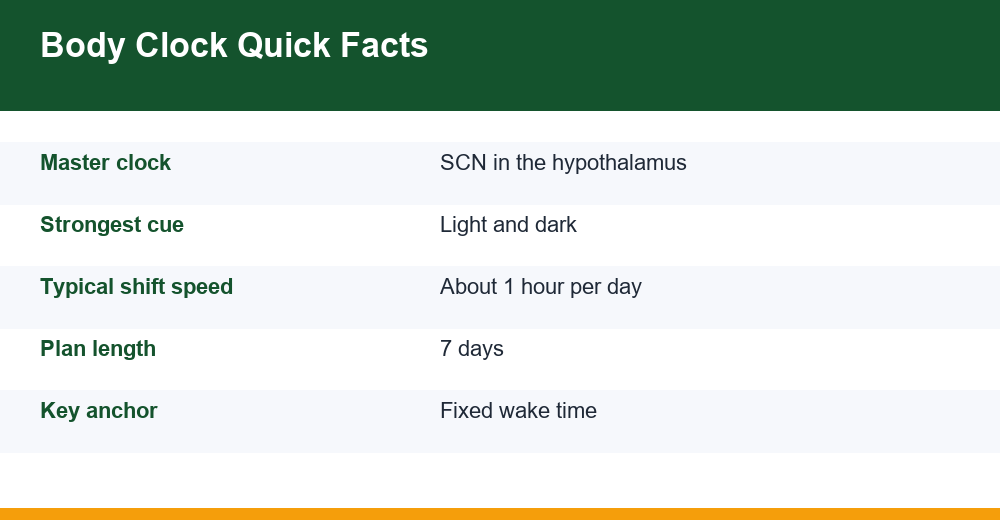
Your circadian rhythm is the roughly 24-hour cycle that shapes when you feel alert, when you get sleepy, when you’re hungry and even when your body temperature rises and falls. It isn’t a vague idea. A small cluster of nerve cells in the hypothalamus, the suprachiasmatic nucleus (SCN), acts as the master clock and keeps the many smaller clocks in your organs roughly in step.
According to the National Institute of General Medical Sciences circadian rhythms fact sheet, light and dark have the biggest influence on these cycles, while food intake, physical activity, stress, temperature and your social environment also play a part. The SCN also uses light information to regulate melatonin, the hormone that rises in the evening and helps make you sleepy.
The science is serious enough that the 2017 Nobel Prize in Physiology or Medicine went to Jeffrey Hall, Michael Rosbash and Michael Young for uncovering how these clocks work at the molecular level.
“Resetting” simply means moving that clock so it lines up with the schedule you actually want to live. Your clock already resets a little every day, nudged by morning light. When it drifts, you’re not broken. You’ve just been sending it mixed signals.
Signs your clock is out of sync
- You can’t fall asleep until 1 or 2 a.m., even when you’re tired.
- Mornings feel foggy for hours, no matter how much coffee you drink.
- Weekend sleep-ins push your Monday bedtime later and later.
- You feel hungry at odd hours or have no appetite at breakfast.
- You wake in the small hours and can’t drift back off.
That last one has several possible causes beyond timing, so if it’s your main issue, our guide to why you keep waking up at 3am is worth reading alongside this plan.
How Long Does It Take to Reset Your Body Clock?
For most healthy adults, the clock shifts by about one hour per day when the right cues are in place. That’s an approximate figure, and it varies with age, how consistent you are and which direction you’re moving. Shifting later tends to be easier than shifting earlier, because the natural human cycle runs a little longer than 24 hours.
So the honest length of a circadian rhythm reset depends on how far you need to go. A one-hour drift might settle in a few days. A night owl who wants to move from a 2 a.m. bedtime to 11 p.m. is looking at roughly a week or more of consistent effort.
| Situation | Shift needed | Realistic timeline (approx.) |
|---|---|---|
| Clock change (autumn) | 1 hour | 2 to 4 days |
| Holiday or weekend drift | 1 to 2 hours | 3 to 5 days |
| Night owl moving earlier | 2 to 3 hours | 1 to 2 weeks |
| Jet lag, 5 to 6 time zones | 5 to 6 hours | About 4 to 7 days |
| Switching to night shifts | 8+ hours | Often partial; can take weeks |
Can you reset it in one day?
Not fully. You can force yourself out of bed early tomorrow, but the internal processes behind sleepiness, such as evening melatonin release, won’t jump three hours overnight. One very early day usually leaves you exhausted by mid-afternoon and wired again at night.
What one day can do is start the process. A fixed wake time plus bright morning light on day one is the most important step you’ll take all week, because everything else builds on it.
The Four Levers That Move Your Clock
Every effective plan relies on the same four cues, often called zeitgebers (German for “time givers”). Used together, they tell your body clearly what time it is.
| Lever | How strong | What to do |
|---|---|---|
| Light | Strongest cue | Bright light soon after waking; dim light in the evening |
| Fixed wake time | Anchors everything | Same alarm every day, weekends included |
| Meal timing | Moderate, mainly organ clocks | Regular breakfast; finish dinner 2 to 3 hours before bed |
| Movement | Supporting cue | Daytime activity, ideally outdoors; avoid hard late-night workouts |
Does morning sunlight really help reset your body clock?
Yes, and this is the best-supported part of any reset. Light reaching the eyes in the morning advances the clock, making you sleepy earlier that night. Bright light late in the evening does the opposite and delays it.
Outdoor daylight is far brighter than typical indoor lighting, even on a cloudy day. Aim for 15 to 30 minutes outside within the first hour of waking. Never look directly at the sun; just be outdoors with your eyes open, walking or sipping a drink.
Does meal timing affect your circadian rhythm?
It does, though mostly through the clocks in your organs rather than the master clock in the brain. In a 2017 study published in Current Biology, ten healthy young men had their meals delayed by five hours. Their blood glucose rhythm shifted by about the same amount, while melatonin and cortisol, markers of the brain’s master clock, didn’t move.
The takeaway: regular meal times help keep your body’s internal clocks aligned with the master clock. A consistent breakfast reinforces morning, and an early, lighter dinner avoids sending a “daytime” message at night. It was a small study of men only, so treat this as a supporting habit, not a standalone fix.
Movement and the wake-time anchor
Exercise acts as a modest timing cue on its own, and it works best when combined with daylight. A brisk morning walk delivers both at once. The fixed wake time matters more than bedtime, because you can control when you get up, but you can’t force sleep.
Caffeine, alcohol and evening screens
These don’t move the clock much directly, but they can sabotage the plan. Caffeine lingers in the body for hours, so an afternoon coffee can keep you alert just as your new bedtime arrives. Alcohol may make you drowsy at first, yet it tends to fragment sleep later in the night.
Bright screens held close to your face late in the evening add light at exactly the wrong time. Switching to night mode, lowering brightness and putting the phone down for the last hour all help your evening melatonin rise on schedule.
The 7-Day Circadian Rhythm Reset Plan
This circadian rhythm reset plan assumes you want to move your schedule earlier, which is the most common goal. Pick your target wake time before you begin. If it’s more than about two hours earlier than your current natural wake time, move toward it in 30 to 60 minute steps rather than all at once.
Day 1: Set the anchor
- Get up at your first-step wake time, even if you slept badly.
- Go outside for 15 to 30 minutes within an hour of waking.
- Eat breakfast within roughly an hour of getting up.
- Stop caffeine by early afternoon.
- Dim the lights about two hours before bed.
Day 2: Hold steady
Expect to feel tired. That’s useful, because sleep pressure is building at the right end of the day. Repeat everything from day one. Resist a long nap; if you must rest, keep it under 20 to 30 minutes and before mid-afternoon.
Day 3: Add movement
Fold some activity into your morning light session, such as a walk, cycle or outdoor stretching. Keep evening exercise gentle. Set a fixed dinner time 2 to 3 hours before your target bedtime.
Day 4: Shift the next step
If your first step has settled, move your wake time another 30 to 60 minutes earlier. Your bedtime follows naturally; go to bed when you feel sleepy, not just because the clock says so.
Day 5: Tighten the evening
- Screens off or on night mode at least an hour before bed.
- Keep the bedroom cool, dark and quiet.
- Use the same short wind-down ritual every night: reading, a warm shower or light stretching.
If you’re curious about gentle options such as chamomile or magnesium, our overview of natural sleep aids covers what the evidence does and doesn’t support.
Day 6: Protect the weekend
This is where most resets collapse. Keep the same wake time. A lie-in of more than an hour acts a little like flying a time zone west and can undo days of work. If you’re short on sleep, a short early-afternoon nap is a better trade.
Day 7: Review and lock it in
Check in honestly. Are you waking near your alarm? Getting sleepy at a sensible hour? If so, the job now is maintenance. Building those morning steps into a simple morning routine for wellness makes them automatic rather than something you have to remember.
| Day | Main focus | Non-negotiable |
|---|---|---|
| 1 | Anchor wake time | Morning daylight |
| 2 | Hold steady | No long naps |
| 3 | Add movement | Fixed dinner time |
| 4 | Next wake-time step | Bed only when sleepy |
| 5 | Evening light and screens | Dim lights 1 to 2 hours before bed |
| 6 | Weekend consistency | Same alarm |
| 7 | Review | Turn it into a routine |
If progress stalls, don’t push harder. Hold your current wake time for a few extra days until it feels natural, then take the next step. A slower circadian rhythm reset that sticks beats a fast one that collapses on Saturday.
Should You Stay Up All Night to Fix Your Sleep?
It’s a popular shortcut: skip a night, crash early the next evening and wake up “fixed.” Sleep specialists generally advise against it. An all-nighter builds huge sleep pressure, but it doesn’t move the underlying clock much.
The result is often a crash at the wrong time, such as falling asleep at 7 p.m., waking at 3 a.m. and starting the cycle again. Meanwhile your concentration, mood and reaction time suffer the next day, which makes driving genuinely risky.
- Instead of staying up all night, wake at a fixed time and get morning light.
- Instead of one big jump, shift 30 to 60 minutes every day or two.
- Instead of long recovery naps, use a short nap before mid-afternoon if needed.
Night Owls, Jet Lag and Shift Work
Night owls
Some people are genuinely late chronotypes, and teenagers naturally run later too. You can still shift earlier, but it takes more consistency. Morning light and avoiding bright evening light matter even more for you, and weekend lie-ins are the biggest trap.
Jet lag
CDC travel guidance suggests starting a few days before departure by moving your bedtime an hour or two earlier for eastward trips, or later for westward ones. Daylight at your destination then helps finish the shift. A common rule of thumb is that recovery takes about a day per time zone crossed, though this varies. Eastward travel is usually harder because it asks the clock to run early.
- On arrival, eat and sleep on local time straight away.
- Heading east, seek morning light and avoid late-evening light.
- Heading west, get light in the late afternoon and early evening.
- Ask a healthcare professional before using melatonin, especially if you take other medication.
Shift work
Rotating shifts make a full reset difficult, and many shift workers never completely adapt. Helpful habits include wearing sunglasses on the commute home after a night shift, sleeping in a blacked-out room and keeping the same sleep window on consecutive shifts. If you can influence your rota, forward-rotating schedules (day to evening to night) are generally easier on the body than backward ones.
Resetting Your Sleep After the Clocks Change
In 2026, clocks in the UK went back on Sunday 25 October, and most of the US falls back on Sunday 1 November. The autumn change gives you an extra hour, which feels easy, but many people wake an hour early and feel sleepy too early in the evening for several days.
A one-hour change is the gentlest circadian rhythm reset you’ll ever face. Try this approach:
- In the three or four days before the change, push bedtime and wake time about 15 minutes later each day.
- On the Sunday, wake at your usual clock time, not the old one.
- Get outside in the morning light, then seek extra daylight in the late afternoon to hold your evening alertness.
- Keep meals on the new clock time from day one.
- Give it a few days before judging; most people settle within a week.
If the change has already happened, simply start from step two. The spring change, when you lose an hour, is usually harder. Use the same method in reverse, moving 15 minutes earlier each day.
When a Reset Isn’t Enough
A natural circadian rhythm reset works well for drift caused by habits, travel and seasonal clock changes. It’s not a cure for every sleep problem. If you’ve followed the plan consistently for two to three weeks and nothing has changed, talk to a GP or doctor.
- Loud snoring, gasping or pauses in breathing at night.
- Daytime sleepiness that’s affecting work, study or driving.
- Low mood, anxiety or racing thoughts that keep you awake.
- A sleep schedule that stays far off despite strict routines, which can point to a circadian rhythm sleep disorder.
- Any new sleep problem linked to medication or a health condition.
This article is general wellness information, not medical advice. A professional assessment can rule out conditions such as sleep apnoea or delayed sleep phase disorder, which need targeted treatment rather than a home routine.
Frequently Asked Questions
How long does it take to reset your circadian rhythm?
For most healthy adults, the body clock moves about one hour per day with consistent cues, though this is approximate. A one-hour drift, like the autumn clock change, often settles in a few days. Moving a bedtime two or three hours earlier usually takes one to two weeks of a fixed wake time, morning light and regular meals.
Can you reset your circadian rhythm in one day?
No. You can wake early for a day, but evening melatonin release and other internal signals won’t shift several hours overnight. One drastic day usually leaves you tired in the afternoon and alert again at night. Day one is still vital, because a fixed wake time and morning light start the shift that the following days build on.
Should I stay up all night to fix my sleep schedule?
Sleep specialists generally advise against it. Staying awake builds intense sleep pressure but barely moves your body clock, so you often crash early, wake in the small hours and repeat the cycle. It also impairs concentration and makes driving dangerous. Gradual shifts of 30 to 60 minutes with morning daylight work better and feel far less punishing.
Does meal timing affect your circadian rhythm?
Yes, mostly through the clocks in organs and tissues such as body fat rather than the brain’s master clock. A 2017 study found that delaying meals by five hours shifted blood glucose rhythms without moving melatonin. Regular breakfast and an earlier, lighter dinner help keep those body clocks aligned with your light-driven schedule.