
Natural sleep aids are the gentle habits, calming rituals, and time-honoured traditions people reach for when they want to rest better without turning straight to medication. None of them is a magic switch, but layered together they can quietly steer your body toward deeper, steadier sleep. This guide walks through ten of the most dependable, grounded in what sleep science supports and honest about where the evidence is still thin.
Table of Contents
What Are Natural Sleep Aids, Really?
The term covers a broad, friendly family of approaches: how you set up your bedroom, the rhythm of your day, what you eat and drink, and the herbal and relaxation rituals that help your mind switch off. It helps to picture natural sleep aids as supports for your body’s own sleep system rather than replacements for it.
One honest note up front: natural does not automatically mean gentle, effective, or safe for everyone. Some herbs interact with medication, and supplements are far less tightly regulated than prescription drugs, so quality and strength can vary widely between products.
The most dependable methods also tend to be the least glamorous, such as keeping a steady schedule and a cool, dark room. The upside is that they cost little, carry almost no risk, and usually improve how you feel during the day as well as at night.
- Habits and timing, such as a consistent sleep-and-wake schedule
- Environment, including light, temperature, and noise
- Relaxation, from slow breathing to a calm wind-down routine
- Food and drink, both what to enjoy and what to limit
- Herbal and traditional rituals, like a warm evening tea
Set a Steady Sleep Schedule and Morning Light
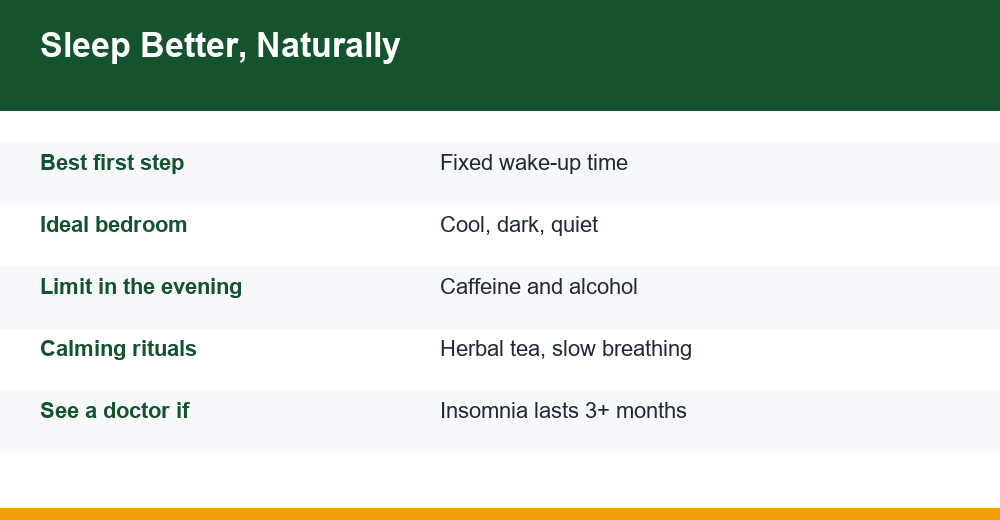
Your body runs on an internal clock, and the single most powerful thing you can do for it is wake up at the same time every day, weekends included. A steady rise time anchors your whole rhythm and makes it far easier to feel naturally sleepy at a sensible hour.
Light is that clock’s main signal. Getting outdoors for daylight within an hour or two of waking tells your brain it is daytime, helping you feel alert in the morning and drowsy when night comes. In the evening, do the opposite and let your surroundings grow dim as bedtime approaches.
Consistency matters more than a perfect bedtime. If you go to bed a little late, still get up at your usual time, and your body will nudge you to sleep earlier the following night. Long or late naps can blunt that pressure to sleep, so keep any daytime rest short.
Daytime movement helps as well. Regular physical activity, even a brisk daily walk, tends to deepen sleep, though vigorous exercise close to bedtime can leave some people wired, so try to finish energetic workouts a couple of hours before you turn in.
- Choose a wake time you can keep seven days a week
- Step outside for 10 to 20 minutes of morning daylight
- Skip long naps, especially after mid-afternoon
- Let evening lighting soften in the last hour before bed
Make Your Bedroom Cool, Dark, and Quiet
A restful bedroom quietly does a lot of the work. Most people sleep best in a room that is cool, dark, and quiet, and reserving the bed mainly for sleep helps your brain associate it with rest rather than scrolling, working, or worrying.
You do not need to spend much to get there. Blackout curtains or an eye mask, a fan or a pair of earplugs, and a thermostat nudged a little cooler at night can each make a noticeable difference to how easily you drift off.
Comfort counts too. A supportive pillow, breathable bedding, and a tidy, uncluttered space all send the same message to your nervous system: this is a place to unwind. Small touches like these add up over the weeks.
- Keep the room cool; many people prefer roughly 16 to 19C (60 to 67F)
- Block stray light with curtains, an eye mask, or by covering LEDs
- Soften noise with earplugs, a fan, or steady background sound
- Keep work, television, and heated conversations out of the bedroom
Dim the Screens and Build a Wind-Down Routine
Screens keep us awake in two ways at once. The bright light nudges the brain toward daytime mode, and the content itself, from work emails to gripping videos and endless feeds, keeps the mind switched on. Setting devices aside 30 to 60 minutes before bed gives your system room to downshift.
In place of scrolling, build a short, repeatable wind-down routine. Doing the same simple things in the same order each night tells your brain that sleep is coming, so the transition starts to feel automatic rather than forced.
The routine can be pleasantly low effort: dim the lights, take a warm shower or bath, and read a few pages of something undemanding. A warm bath an hour or so before bed can help by letting your body cool down afterwards, which many people find supports sleep.
Be patient with yourself here, too. Old scrolling habits are sticky, so start small, perhaps with just the last fifteen minutes screen-free, and extend the window as it begins to feel normal rather than like a punishment.
- Put phones and laptops away before you get into bed
- Swap late scrolling for reading, stretching, or quiet music
- Keep the routine short and roughly the same each night
- If a phone must stay nearby, use night mode and turn it face down
Relaxation, Breathing, and a Calmer Mind
For many people the real obstacle is not the body but a busy mind. Daytime stress has a habit of surfacing the moment the lights go out, which is why learning to lower stress naturally during the day often does more for your nights than any single bedtime trick.
Simple relaxation practices calm the nervous system and are safe for almost everyone. Slow breathing, gentle muscle relaxation, and a few minutes of quiet attention can ease the shift from a racing head into sleep. A basic breathing pattern is a good place to start.
- Breathe in slowly through your nose for a count of four
- Let the breath rest for a moment
- Breathe out gently for a count of six
- Repeat for a few minutes, letting the longer exhale lead
If your mind keeps circling the same worries, try writing them down earlier in the evening, along with any small next step. Putting concerns on paper can help you set them aside for the night rather than rehearsing them in the dark.
Herbal Teas, Aromas, and Gentle Rituals
A warm, caffeine-free drink is one of the most comforting bedtime rituals, and the ritual itself, the warmth and the pause, is part of why it soothes. Herbal brews are among the best-loved natural sleep aids, valued for a long tradition of use in winding down; our guide to herbal teas for sleep goes deeper, while the table below sums up the popular options.
Keep expectations realistic. The evidence for these herbs is modest and mixed rather than conclusive, so it is fairest to treat them as pleasant supports for winding down, not treatments, and a few carry real cautions worth respecting.
| Herbal option | Traditionally used for | Keep in mind |
|---|---|---|
| Chamomile | Winding down and calm | Avoid if allergic to ragweed or daisies; caution in pregnancy |
| Valerian | A relaxed, sleepy feeling | Evidence mixed; avoid in pregnancy and breastfeeding |
| Lavender | Relaxation and aroma | Popular as a scent; dilute essential oils well |
| Lemon balm | Easing restlessness | Generally gentle; start with a small amount |
| Peppermint | A soothing evening cup | Not sedating, but calming as a ritual |
A gentle reality check about warm milk and other bedtime staples: much of their benefit is likely the comfort and routine rather than a strong chemical effect. That is perfectly fine. A calming ritual you genuinely enjoy and repeat is worth more than a powerful-sounding remedy you dread.
Lavender is also widely used in aromatherapy, with a few drops on a tissue or in a diffuser. If you use essential oils, dilute them properly, keep them well away from children and pets, and never swallow them. When you are unsure whether a herb suits you or your medication, a quick word with a pharmacist is worth it.
Food, Drink, and Magnesium-Rich Meals
What you eat plays a quiet supporting role. Foods rich in magnesium, such as leafy greens, nuts, seeds, beans, and wholegrains, are part of a balanced diet that supports overall wellbeing, and a light, satisfying evening meal usually sits better than a heavy or very late one.
Two everyday drinks deserve special attention. Caffeine is a stimulant that can linger in the body for hours, so an afternoon coffee or energy drink may still be quietly at work at bedtime. Alcohol is trickier: it can make you drowsy at first, then fragment your sleep in the second half of the night and leave you less rested.
| What to limit | Why it matters | A gentle guideline |
|---|---|---|
| Caffeine | A stimulant that lingers | Ease off from early afternoon |
| Alcohol | Fragments later sleep | Keep it earlier and modest |
| Large, late meals | Digestion can disrupt rest | Finish eating a few hours before bed |
Rather than banning anything outright, experiment with timing. Many people notice a real improvement simply by moving their last coffee earlier in the day and keeping any evening drink light. Staying comfortably hydrated helps too, though it is worth easing off large amounts of fluid right before bed.
If you wake in the night feeling hungry, a small, plain snack is fine and better than lying awake; think of a little yoghurt, a banana, or a few oats rather than anything rich, sugary, or heavily spiced.
Putting It All Together: A Gentle Evening Routine
No single habit does all the work, so the real skill is stacking a few of them into a routine you will actually keep. Think of the evening as a slow dimmer switch rather than an on-off button, with each small step signalling to your body that the day is winding down.
The sample below is a flexible template, not a rulebook. Pick two or three steps that appeal to you, repeat them for a week or two, and notice what genuinely helps. Consistency usually matters far more than doing everything perfectly on any single night.
| Time before bed | What to try | Why it can help |
|---|---|---|
| 3 hours | Finish any large meal or last coffee | Gives digestion and caffeine time to settle |
| 1 hour | Dim the lights and step away from screens | Lets your body ease toward its natural rhythm |
| 30 minutes | Warm shower, herbal tea, or light reading | A familiar cue that sleep is on the way |
| At bedtime | Slow breathing in a cool, dark room | Helps calm the mind and body for rest |
It also helps to notice what quietly works against you. A few everyday habits undo good intentions, and easing off them is often as useful as adding anything new to your evening.
- Sleeping in late on weekends, which unsettles your body clock
- Using the bed for work, worry, or endless scrolling
- Relying on a nightcap, since alcohol tends to disrupt later sleep
- Checking the clock over and over when you wake in the night
Melatonin, Caution, and When to See a Doctor
Melatonin is a hormone your body releases as darkness falls, and supplement versions are among the most talked-about of all natural sleep aids. It can be helpful in specific situations, such as jet lag or shift work, and it is generally considered reasonable for short-term use in adults.
Even so, many experts do not treat it as a first choice for ordinary sleeplessness. It can interact with medicines including blood thinners, blood pressure drugs, and diabetes treatments; it may leave you groggy the next day; and it is wise to avoid driving for several hours after taking it. Strength and quality vary between brands, and it is not recommended for children or during pregnancy without medical advice.
Lifestyle changes help most people, but they are not a substitute for care when something more is going on. If poor sleep lasts more than about three months, disrupts your days, or comes with loud snoring, gasping, or low mood, it is worth seeing your doctor. A talking therapy known as CBT-I is often recommended for persistent insomnia, and the Sleep Foundation is a trustworthy place to read more.
- Trouble sleeping most nights for three months or longer
- Loud snoring, gasping, or pauses in breathing at night
- Persistent low mood, anxiety, or daytime exhaustion
- Sleep problems that began with a new medication
One final note: this article is general information about lifestyle and traditional wellbeing, not medical advice, and none of these habits or herbs is a treatment or cure for any condition. Everyone is different, so please check with a qualified professional, especially if you are pregnant, breastfeeding, taking medication, or managing a health condition, before trying a new supplement or herb.
Frequently Asked Questions
What is the most effective natural sleep aid?
There is no single winner, but the most reliable natural sleep aids are behavioural rather than herbal: a consistent wake-up time, a cool and dark bedroom, and a calming wind-down routine. Herbal teas and relaxation add gentle support and work best alongside these steady daily habits.
How long do natural sleep remedies take to work?
Give them time. Habits like a fixed wake time or reduced evening caffeine often need one to two weeks of consistency before you notice steadier sleep. A calming tea or breathing exercise can feel soothing the same night, but lasting change comes from repeating the basics.
Are herbal sleep teas safe during pregnancy?
Not always. Some popular herbs, including valerian and chamomile, are best avoided or used only with medical guidance during pregnancy and breastfeeding. Herbs can also interact with medication. If you are pregnant, nursing, or taking any prescription, check with your doctor or pharmacist before trying a new tea.
Is melatonin a good natural sleep aid?
Melatonin can help with jet lag or shift work and is generally considered reasonable short-term, but it is not a first choice for everyday sleeplessness. It may interact with some medicines and cause morning grogginess. Try lifestyle changes first, and speak to a professional before using it regularly.