
If you want to increase fiber without bloating, how fast you add it matters as much as which foods you choose. Gut bacteria need time to adapt, and a sudden jump from a low-fiber diet to a heaping bowl of beans and bran is what usually triggers the gas. This guide gives you a slow, practical plan, the foods that tend to be gentlest and the signs that more fiber may not suit you right now.
Table of Contents
What Is Fibermaxxing?
Fibermaxxing is a social media trend, popular on TikTok and Instagram through 2025 and 2026, in which people deliberately push their daily fiber intake up, mostly with beans, lentils, berries, seeds, whole grains and vegetables. It grew partly as a reaction to the long-running focus on protein, with fiber pitched as the nutrient most people are actually missing.
The core idea is sound. Most adults eat well below the recommended amount, and fiber-rich plant foods are linked with regular bowel habits, steadier blood sugar after meals, healthier cholesterol levels and a more diverse gut microbiome. Many registered dietitians have welcomed the attention for exactly that reason.
Where the trend goes wrong is speed and scale. Some creators post days of 50 grams or more, often reached almost overnight with powders and bran. That is a reliable recipe for gas, cramping and a swollen belly. The better version of fibermaxxing is slower, food-first and focused on variety rather than chasing a record number.
- Good part: more plants, more often, from many different sources.
- Risky part: big jumps in grams, heavy reliance on supplements and too little fluid.
- Realistic goal: reach the official recommendation for your age and sex, then stay there consistently.
How Much Fiber Should You Eat a Day?
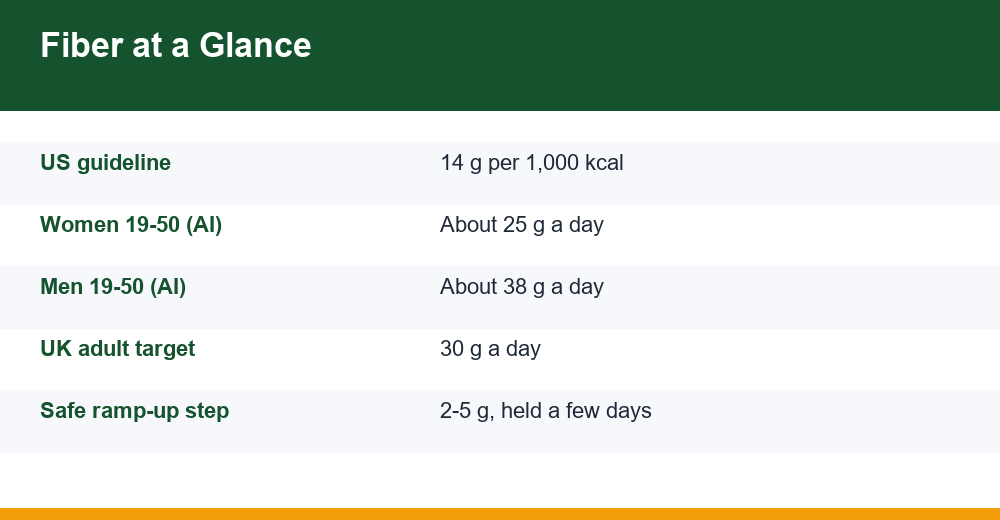
The Dietary Guidelines for Americans use a simple rule: about 14 grams of fiber for every 1,000 calories you eat. On a 2,000-calorie diet, that works out to roughly 28 grams a day.
The Adequate Intake values set by the US Institute of Medicine (now the National Academy of Medicine) are also widely quoted: about 25 grams a day for women and 38 grams for men aged 19 to 50, falling to about 21 and 30 grams after 50. The UK sets a single adult target of 30 grams a day. In practice, all of these land in a range of roughly 25 to 38 grams.
| Group | Typical daily target | Notes |
|---|---|---|
| Women 19-50 | About 25 g | US Adequate Intake |
| Men 19-50 | About 38 g | Higher calorie needs |
| Adults 51 and over | About 21 g (women) / 30 g (men) | Based on lower energy intake |
| UK adults | 30 g | NHS and SACN recommendation |
| Any adult, by calories | 14 g per 1,000 kcal | Dietary Guidelines rule of thumb |
US dietary surveys have long found that average intake sits well below these targets, at roughly 15 to 17 grams a day for many adults, and only a small minority reach the recommendation. So if you currently eat around 15 grams, the goal is not to hit 50 by Friday. It is to close a gap of 10 to 20 grams over several weeks.
Why Does Fiber Make You Bloated?
Your small intestine cannot digest fiber. Much of it travels to the large intestine, where gut bacteria ferment it. That fermentation produces useful compounds such as short-chain fatty acids, but it also releases gas: mainly hydrogen and carbon dioxide and, in some people, methane.
When you raise fiber suddenly, your microbes get far more fuel than usual and gas production spikes before your gut has adapted. Add too little water, and bulkier stool can move more slowly, which adds to the feeling of fullness and pressure.
Soluble vs insoluble fiber
Fiber comes in two broad types, and most plant foods contain both. Soluble fiber absorbs water and forms a gel, which slows digestion. Insoluble fiber adds bulk to stool and helps it move through the intestines more quickly. How gassy a fiber is depends less on this label and more on how quickly gut bacteria can ferment it.
| Feature | Soluble fiber | Insoluble fiber |
|---|---|---|
| What it does | Forms a gel, slows digestion | Adds bulk, speeds transit |
| Main sources | Oats, chia, psyllium, beans, citrus, apples | Wheat bran, whole grains, nuts, vegetable skins |
| Gas potential | Varies: psyllium is low, beans are high | Bran bothers many sensitive guts |
| Best for | Softer stools, cholesterol, fullness | Regularity, stool bulk |
Some carbohydrates that travel with fiber are especially fermentable, notably the galacto-oligosaccharides (GOS) in beans and lentils and the fructans in wheat, onion, garlic and the inulin or chicory root added to many processed foods. These are the usual suspects when gas is the main complaint.
How to Increase Fiber Without Bloating: 7 Steps
There is no single trick. To increase fiber without bloating, you combine a slow pace with a few habits that make each extra gram easier to handle.
How do I add more fiber without gas?
- Start from your real baseline. Log two or three ordinary days in a food-tracking app. Many people overestimate their intake, and knowing your starting point shows how big the gap really is.
- Add 2 to 5 grams at a time. That is roughly one piece of fruit, a tablespoon of chia seeds or a serving of cooked vegetables. Hold each new level for several days before adding more.
- Spread fiber across the day. A 15-gram breakfast followed by little else is harder on the gut than 7 to 8 grams at each meal and snack.
- Drink more as fiber rises. Soluble fiber needs water to form its gel, and stool needs fluid to stay soft. Use the tips in our guide on how to stay properly hydrated and add a glass of water with your highest-fiber meals.
- Favor gentler foods first. Begin with oats, kiwi, berries, carrots and quinoa before moving on to beans, bran and large raw salads.
- Prepare foods to reduce gas. Rinse canned beans and lentils, start with small portions and cook vegetables rather than eating them all raw. Cooking softens fiber, and many people find it easier to tolerate.
- Keep moving. A 10 to 20 minute walk after meals helps gas move through the gut and supports regular bowel movements.
If bloating appears, do not abandon the plan. Drop back to the last comfortable level for a few days, then try a smaller step. Health services such as MedlinePlus and the NHS give the same basic advice: increase fiber gradually and drink plenty of fluids.
What about fiber supplements?
Food should do most of the work, because whole foods bring a mix of fiber types plus vitamins and polyphenols. If you use a supplement, psyllium is generally one of the better-tolerated options. Start with a small dose, take it with a full glass of water and follow the label on spacing it from medicines, usually by about two hours, as fiber can affect how some drugs are absorbed.
A 4-Week Ramp-Up Plan
This plan assumes a starting point of around 15 grams a day and a target near 30 grams. Adjust the numbers to your own baseline. What matters is the shape of the plan: small steps, held long enough for your microbes to adapt.
| Week | Daily target (approx.) | What to add | Focus |
|---|---|---|---|
| Week 1 | 18-20 g | Oats or a whole-grain cereal at breakfast, one extra fruit | Soluble fiber, extra water |
| Week 2 | 22-24 g | Cooked vegetables at lunch and dinner, a small handful of nuts | Spread fiber over 3-4 meals |
| Week 3 | 25-27 g | 1/4 cup rinsed canned lentils or chickpeas, swap to whole-grain bread | Introduce legumes slowly |
| Week 4 | 28-30 g | Increase legumes to 1/2 cup, add chia or ground flaxseed | Variety and consistency |
Some people move faster; others need six to eight weeks, especially if they start very low. That is normal. A slower path you can keep up beats a quick one that leaves you uncomfortable and ready to quit.
How long does it take your body to adjust to more fiber?
For most people, gas and bloating settle within a few weeks of a gradual increase, which is why official advice is to build up over that kind of period rather than in a day. Each step up may bring a few days of extra gas before things calm down again. If symptoms persist for weeks even at a modest intake, talk to a doctor rather than pushing on.
Tracking how you feel matters as much as tracking grams. A one-word note each evening (comfortable, mild gas, bloated) makes it easy to see which step or which food is the problem when you are trying to increase fiber without bloating.
High-Fiber Foods That Cause the Least Bloating
Tolerance is personal, but some foods are consistently easier on the gut because their fiber is fermented more slowly or they are low in FODMAPs at normal portions. They make good starting points when you want to increase fiber without bloating, and many overlap with our list of foods that support gut health.
| Food | Portion | Fiber (approx.) | Why it tends to be gentle |
|---|---|---|---|
| Rolled oats | 1/2 cup dry | 4 g | Rich in soluble beta-glucan |
| Kiwifruit | 2 medium | 4 g | Well tolerated, supports regularity |
| Raspberries | 1/2 cup | 4 g | Low FODMAP in modest servings |
| Chia seeds | 1 tbsp | About 4 g | Gel-forming, easy to add |
| Quinoa | 1 cup cooked | 5 g | Gluten-free, low in fructans |
| Carrots | 1/2 cup cooked | 2-3 g | Cooked fiber is softer |
| Potato with skin | 1 medium | About 4 g | Mild, familiar, easy to portion |
| Psyllium husk | 1 rounded tsp | About 3 g | Ferments slowly, less gas than bran |
Foods that more often cause gas include large servings of beans and lentils, cabbage, cauliflower, onions, garlic, wheat bran and products with added inulin or chicory root. You do not need to avoid them. Just add them later in your plan and in smaller amounts.
- Choose canned and rinsed legumes over home-cooked dried ones at first; some of the gas-forming carbohydrates leach into the canning liquid.
- Eat ripe rather than very firm fruit if raw fruit bothers you.
- Check labels on high-fiber bars and drinks for inulin or chicory root, which can cause gas even at modest doses.
A Sample Day at About 30 Grams
Here is what a comfortable 30-gram day might look like once you have worked up to it. The fiber values are approximate and vary by brand and portion size.
| Meal | What to eat | Fiber (approx.) |
|---|---|---|
| Breakfast | Oats (1/2 cup dry) with 1/2 cup raspberries and 1 tbsp ground flaxseed | 10 g |
| Lunch | Quinoa bowl (1/2 cup cooked) with 1/4 cup rinsed chickpeas, leafy greens, olive oil and lemon | 6-7 g |
| Snack | 2 kiwifruit | 4 g |
| Afternoon | Small handful of almonds (about 1 oz) | 3-4 g |
| Dinner | Baked salmon, medium potato with skin, 1/2 cup cooked carrots | 6-7 g |
| Total | About 30 g |
No single meal carries the whole load. Each one adds a modest amount, which is far easier on your gut than one giant fiber bomb. Pair every meal with a glass of water and you have covered the two biggest causes of fiber-related discomfort.
If constipation is the reason you are adding fiber, some people also look at magnesium. Our comparison of magnesium glycinate vs citrate explains why citrate has the stronger laxative effect, though food changes and fluids come first.
When Extra Fiber May Not Suit You
More fiber is good advice for most healthy adults, but not for everyone in every situation. This blog is informational, not medical advice, so check with your doctor or a registered dietitian if any of the following apply.
- Irritable bowel syndrome (IBS): insoluble fiber such as wheat bran can worsen bloating in some people with IBS, while soluble options such as oats or psyllium are often better tolerated. A dietitian-guided low-FODMAP approach can help identify triggers.
- Inflammatory bowel disease (IBD): during a flare of Crohn’s disease or ulcerative colitis, or if you have a narrowing (stricture) of the bowel, your care team may advise limiting fiber for a time.
- Recent bowel surgery or a diverticulitis flare: follow the specific diet your clinician gives you during recovery.
- Gastroparesis or slow stomach emptying: large amounts of fiber can make symptoms worse.
- Medications: fiber supplements can affect the absorption of some drugs, so space them out and ask your pharmacist.
Also seek medical advice if bloating comes with weight loss you cannot explain, blood in your stool, persistent pain, vomiting or a lasting change in bowel habits. These are not normal fiber side effects and need checking.
For everyone else, the formula is simple: know your baseline, add small amounts, drink enough, keep moving and give your body a few weeks. Done that way, you can increase fiber without bloating and keep the habit for good. The MedlinePlus overview of dietary fiber is a reliable place to read more about fiber types and food sources.
Frequently Asked Questions
How much fiber should I eat a day?
Most adults need roughly 25 to 38 grams a day. US guidelines suggest about 14 grams per 1,000 calories, or around 28 grams on a 2,000-calorie diet, while the UK recommends 30 grams for adults. Women generally need less than men, and US targets fall slightly after age 50. Build up to your target gradually rather than all at once.
Why does fiber make me bloated?
Gut bacteria ferment fiber in the large intestine and produce gas as a by-product. When you add a lot of fiber suddenly, gas production jumps before your gut adapts, and drinking too little fluid can slow things further. Beans, lentils, wheat bran, onions, garlic and added inulin are among the most fermentable, gas-producing sources.
How long does it take your body to adjust to more fiber?
Most people adapt within a few weeks when they increase intake gradually, adding 2 to 5 grams at a time and holding each step for several days. Each step may bring a little extra gas that then settles. If bloating or pain lasts for weeks even at moderate amounts, speak to a doctor or registered dietitian.
Which high-fiber foods cause the least bloating?
Oats, kiwifruit, raspberries, chia seeds, quinoa, cooked carrots, potatoes with skin and psyllium husk tend to be well tolerated because their fiber is fermented more slowly or they are low in FODMAPs. Beans, cabbage, onions, garlic, wheat bran and inulin-fortified products are more likely to cause gas, so add them later and in smaller portions.