
Magnesium glycinate vs citrate is one of the most searched supplement comparisons, and most of the pages answering it are trying to sell you a bottle. This guide takes the neutral route: what each form actually does, what the sleep research really shows, how they treat your gut, and when food alone may be enough. It is general wellness information, not medical advice, so check with a clinician if you take medication or have kidney problems.
Table of Contents
What Is the Difference Between Glycinate and Citrate?
Magnesium on its own is a reactive mineral, so supplements bind it to a carrier molecule. That carrier changes how the product feels in your body, how much actual magnesium you get per capsule, and what it costs. The magnesium itself is identical in both.
Magnesium glycinate (often sold as bisglycinate) pairs magnesium with glycine, an amino acid your body also makes. Magnesium citrate pairs it with citric acid, the compound that makes lemons sour. Both are generally considered better absorbed than magnesium oxide, which packs a lot of magnesium on paper but absorbs comparatively poorly.
The practical differences that matter
- Gut effect: citrate draws water into the intestines and can loosen stools; glycinate is usually gentler.
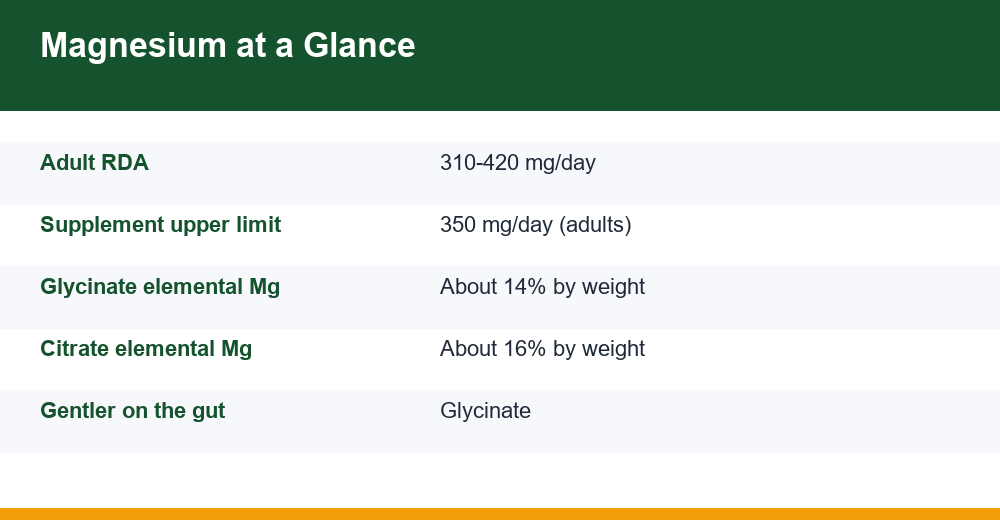
- Elemental content: citrate is roughly 16% magnesium by weight, glycinate roughly 14%, so labels differ in how many capsules you need for the same dose.
- Price: citrate powders and tablets are usually cheaper per milligram of magnesium.
- The carrier: glycine has its own small body of sleep research; citrate has no known calming role.
One honest caveat: there are few good head-to-head trials comparing absorption of these two forms in people. Claims that one is dramatically more bioavailable than the other are marketing, not settled science. Both can raise magnesium status when taken consistently.
It also helps to remember why magnesium matters in the first place. It is involved in hundreds of enzyme reactions, including muscle and nerve function, blood sugar control and energy production. Low intake is common, but true deficiency with obvious symptoms is uncommon in otherwise healthy people, because the kidneys limit magnesium losses when intake drops.
Magnesium Glycinate vs Citrate: Side-by-Side Table
Here is how the two forms compare across the five things people usually care about: sleep, digestion, tolerance, cost and timing. Treat the cost row as a general pattern only, since prices vary widely by brand and country.
| Factor | Magnesium glycinate | Magnesium citrate |
|---|---|---|
| Sleep and relaxation | Popular bedtime choice; glycine carrier may add a mild calming effect | Can help if you are low in magnesium; no extra calming carrier |
| Digestion | Rarely loosens stools at normal doses | Mild osmotic laxative; often used for constipation |
| Tolerance | Usually well tolerated, even on sensitive stomachs | Can cause loose stools, cramping or urgency |
| Elemental magnesium | About 14% by weight | About 16% by weight |
| Typical cost | Usually higher per mg of magnesium | Usually lower per mg of magnesium |
| Sensible timing | Evening, 30-60 minutes before bed | Morning or daytime to avoid night-time bathroom trips |
| Common formats | Capsules, powders | Powders, tablets, liquids |
If you only remember one line from this table: glycinate is the calmer, gut-friendly option, while citrate is the cheaper option that also nudges your bowels. Neither is a sedative, and neither replaces good sleep habits.
A quick word on reading labels. A capsule listing “500 mg magnesium glycinate” may contain only around 70 mg of actual magnesium. Look for the line that states elemental magnesium, or “magnesium (as bisglycinate)”, because that is the number that counts toward your daily intake and the upper limit.
Which Magnesium Is Better for Sleep?
In the magnesium glycinate vs citrate debate, glycinate is the more sensible pick for sleep for most people, but the reason is less magical than supplement ads suggest. The main advantage is tolerance: you can take it at night without worrying about a bathroom trip at 2 a.m. Citrate taken in the evening can undo the very sleep you were hoping to improve.
What the research actually shows
The evidence for magnesium and sleep is modest. A 2025 randomized, placebo-controlled trial published in Nature and Science of Sleep gave 155 adults with self-reported poor sleep 250 mg of elemental magnesium as bisglycinate daily for four weeks. Insomnia Severity Index scores improved somewhat more than with placebo, but the difference was small, and the placebo group improved too.
Earlier reviews of magnesium and insomnia, mostly in older adults, rated the evidence as low quality. The overall pattern suggests magnesium may help most when your intake is genuinely low, and does little for people who already eat enough of it.
Does the glycine matter?
Glycine on its own has been studied for sleep at doses of around 3 grams. A typical glycinate capsule delivers well under that, so the glycine bonus is probably small. It is a reasonable tiebreaker, not a reason to pay a large premium.
Who is most likely to notice a difference
- People whose diet is light on nuts, seeds, legumes, greens and whole grains
- Those with muscle cramps or restlessness at night alongside low intake
- People who have trouble relaxing in the evening and want a gentle, low-risk routine anchor
If your real problem is waking in the small hours rather than falling asleep, look at the broader picture first. Our guide to why you keep waking up at 3am covers blood sugar, stress hormones, alcohol and bedroom temperature, which often matter more than any mineral.
Does Magnesium Citrate Make You Poop?
Yes, it often does, and in some products that is the whole point. Magnesium citrate acts as an osmotic laxative: unabsorbed magnesium pulls water into the bowel, softening stool and speeding things along. High-dose liquid citrate is sold over the counter specifically for constipation and, under medical instruction, bowel preparation.
At ordinary supplement doses the effect is milder, but it varies a lot between people. Some notice nothing; others get loose stools from a modest dose. Glycinate can also cause digestive upset at higher amounts, just less often.
Who might prefer citrate
- People with mild, occasional constipation who also want to top up magnesium
- Anyone on a tight budget who tolerates it well
- People who like a powder dissolved in water
Who might avoid it
- People with irritable bowel syndrome that leans toward diarrhea
- Anyone taking it purely for sleep, since night-time urgency defeats the purpose
- People with reduced kidney function, unless a clinician has approved it
Diarrhea, nausea and stomach cramps are also the first signs of taking too much supplemental magnesium of any form. If citrate upsets your gut, lower the dose or switch to glycinate before giving up on magnesium entirely. Do not use high-dose laxative citrate products regularly without medical guidance.
When Is the Best Time to Take Magnesium?
There is no proven best hour for absorption. Consistency matters far more than the clock. That said, the form you choose points to sensible timing.
- Glycinate for sleep: take it 30 to 60 minutes before bed, ideally as part of a wind-down routine.
- Citrate for regularity: take it in the morning or early afternoon so any laxative effect happens while you are awake.
- Either form with food: taking magnesium with a meal tends to reduce stomach upset.
- Split doses: two smaller doses are often better tolerated than one large one.
- Space it from certain medicines: some antibiotics and osteoporosis drugs need a gap of several hours, covered in the table further down.
Can I take magnesium glycinate every night?
For most healthy adults, a nightly glycinate supplement within the upper limit is generally considered safe. The key is to keep supplemental magnesium at or below 350 mg of elemental magnesium per day unless a doctor advises otherwise, and to count every source, including multivitamins, antacids and laxatives.
Nightly use deserves a pause if you have kidney disease, take medicines that interact with magnesium, or notice persistent diarrhea, low blood pressure, unusual weakness or an irregular heartbeat. Healthy kidneys clear excess magnesium, so impaired kidney function is the main safety concern.
It is also worth asking whether you need it every night at all. Many people do well pairing magnesium with other gentle habits; our roundup of natural sleep aids compares options such as herbal teas, morning light and consistent evening routines.
What Foods Are High in Magnesium?
Before you weigh up magnesium glycinate vs citrate, check your plate. Magnesium from food does not count toward the supplement upper limit, rarely causes digestive trouble, and comes packaged with fiber and other nutrients. Adults need roughly 310 to 420 mg a day depending on sex and age, and many people fall short.
The figures below follow the food table published by the NIH Office of Dietary Supplements; values are rounded and vary by variety and preparation.
| Food | Serving | Magnesium (mg) |
|---|---|---|
| Pumpkin seeds, roasted | 1 ounce | 156 |
| Chia seeds | 1 ounce | 111 |
| Almonds, dry roasted | 1 ounce | 80 |
| Spinach, boiled | 1/2 cup | 78 |
| Cashews, dry roasted | 1 ounce | 74 |
| Peanuts, oil roasted | 1/4 cup | 63 |
| Soymilk, plain | 1 cup | 61 |
| Black beans, cooked | 1/2 cup | 60 |
| Edamame, shelled, cooked | 1/2 cup | 50 |
| Brown rice, cooked | 1/2 cup | 42 |
A handful of pumpkin seeds on yogurt, a bean-based lunch and a portion of leafy greens can cover a large share of daily needs. For more ideas built around nutrient-dense staples, see our practical superfoods guide.
Signs food may not be enough
- Diets low in whole grains, nuts, seeds and legumes
- Heavy alcohol use
- Type 2 diabetes or gut conditions such as Crohn’s disease or celiac disease
- Long-term use of certain diuretics or proton pump inhibitors
- Older age, when absorption tends to fall and urinary losses rise
Upper Limits, Medications and Who Should Be Careful
The tolerable upper intake level for supplemental magnesium is 350 mg a day for adults and children aged nine and over. It applies only to supplements and medicines, not food, and it does not apply to people being treated with magnesium under a doctor’s care.
The NIH Office of Dietary Supplements magnesium fact sheet lists several medication interactions worth knowing:
| Medication type | What happens | General guidance |
|---|---|---|
| Oral bisphosphonates (e.g. alendronate) | Magnesium can reduce drug absorption | Separate by at least 2 hours |
| Tetracycline and quinolone antibiotics | Magnesium binds the drug in the gut | Antibiotic 2 hours before or 4-6 hours after magnesium |
| Loop and thiazide diuretics | Increase magnesium loss in urine | Ask about checking levels |
| Potassium-sparing diuretics | Reduce magnesium excretion | Avoid extra magnesium unless approved |
| Proton pump inhibitors (long-term) | Can lower blood magnesium | Discuss testing if used for over a year |
These cautions apply equally to both sides of the magnesium glycinate vs citrate choice, because the interactions come from the magnesium itself, not the carrier. Some bisphosphonate labels set different spacing, so follow your own prescription leaflet or pharmacist. People with kidney disease, heart rhythm problems, or who are pregnant or breastfeeding should get individual advice before supplementing.
How to Choose Without the Marketing Noise
Strip away the branding and the decision is fairly simple. The magnesium glycinate vs citrate question usually comes down to your gut and your goal, not to a dramatic difference in absorption.
- Start with food for two to three weeks and see whether sleep or cramps change.
- Pick glycinate if your goal is sleep or relaxation, or if your stomach is sensitive.
- Pick citrate if you also deal with mild constipation and want a lower-cost option.
- Start low, around 100 to 200 mg of elemental magnesium, and stay at or under 350 mg from supplements.
- Choose independently tested products and ignore claims of extraordinary absorption.
- Reassess after a month. If nothing has changed, magnesium probably was not your limiting factor.
Watch for blends labeled only as “magnesium complex” or “buffered glycinate”. These can include cheaper magnesium oxide, so check the supplement facts panel for which forms are inside and how much each contributes.
The honest bottom line on magnesium glycinate vs citrate: both are reasonable forms, glycinate suits bedtime better, citrate suits the budget and the bowels, and neither will fix sleep on its own if stress, light, caffeine or an irregular schedule are the real culprits.
Frequently Asked Questions
Which magnesium is better for sleep, glycinate or citrate?
Glycinate is usually the better choice for sleep because it rarely causes loose stools, so it can be taken at bedtime without disrupting the night. Its glycine carrier may add a small calming effect. Citrate can also correct low magnesium intake, but its mild laxative action makes evening doses less practical. Evidence for either form improving sleep is modest.
Can I take magnesium glycinate every night?
Most healthy adults can take magnesium glycinate nightly as long as total supplemental magnesium stays at or below 350 mg of elemental magnesium per day, the adult upper limit. Count multivitamins and antacids too. People with kidney disease or those taking interacting medicines, such as certain antibiotics or bisphosphonates, should check with a doctor or pharmacist first.
When is the best time to take magnesium?
No time of day has been proven to improve absorption, so consistency matters most. Glycinate is usually taken 30 to 60 minutes before bed when the goal is sleep. Citrate is better in the morning or early afternoon so any laxative effect happens while you are awake. Taking either with food can reduce stomach upset.
What foods are high in magnesium?
Pumpkin seeds are among the richest sources at about 156 mg per ounce, followed by chia seeds, almonds, boiled spinach, cashews, peanuts, soymilk, black beans, edamame and brown rice. Whole grains, legumes, nuts, seeds and leafy greens together can cover much of the adult need of roughly 310 to 420 mg per day.