
Magnesium for sleep occupies an unusual position: it is one of the few supplements in this area with real mechanistic grounding, and it is also sold with claims that go far past anything the research supports. Both things are true at once, which makes it hard to get a straight answer. The mineral is genuinely involved in the systems that let the nervous system settle, a meaningful share of adults do fall short of recommended intakes, and supplementing can help some people. It is also not a sedative, will not override a disrupted schedule, and the cheapest form on the shelf is the one least worth buying. This is what is reasonably established, and what is not. It is general information rather than medical advice.
Table of Contents
What magnesium does at night
Magnesium is a cofactor in hundreds of enzyme reactions, and two of its roles matter here. It acts on GABA receptors, the system the body uses to quieten neural activity, and it moderates NMDA receptors, which do the opposite. Loosely, it supports the brake and eases off the accelerator.
It is also involved in muscle relaxation, which is why people low in it often report cramps and restless legs at night, and it plays a part in regulating cortisol, the hormone that should be falling in the evening and frequently is not.
Why this is not the same as a sleeping pill
None of those mechanisms force sleep. They support the conditions under which sleep happens more easily. The practical difference is that somebody who is deficient may notice a real change, while somebody with adequate levels and a 1am screen habit will notice very little, and that is the honest explanation for why reports vary so wildly.
What the evidence supports
The research is real but modest, and worth describing accurately. Trials have most consistently shown benefit in older adults with insomnia symptoms and low magnesium status, where supplementation improved time to fall asleep and sleep efficiency. Those are also the people most likely to be deficient, which is probably not a coincidence.
In younger, well-nourished people the picture is much weaker. Several reviews have concluded the overall quality of evidence is low, with small samples and short durations. That is not the same as saying it does not work; it means the confident claims printed on packaging are running ahead of what has been demonstrated.
The reasonable reading is that magnesium for sleep is most likely to help if you are short of it, and least likely to help if you are not. That makes the question of your own intake the useful place to start, rather than the brand.
Whether you are likely to be short of it
Dietary surveys in several countries consistently find a sizeable proportion of adults taking in less than the recommended amount, with the gap widest among people eating a lot of refined and processed food, since refining strips magnesium out.
Testing is less helpful than it sounds. Most magnesium sits inside cells and in bone, so a standard serum blood test can look normal while tissue stores are low. Doctors use it to catch serious deficiency rather than to fine-tune intake.
- A diet light on nuts, seeds, legumes, leafy greens and wholegrains
- Heavy alcohol use, which increases how much is lost
- Type 2 diabetes and some digestive conditions
- Certain long-term medications, including some diuretics and acid reducers
- Night cramps, eyelid twitching or restless legs alongside poor sleep
None of those proves deficiency. Together they shift the odds enough that trying magnesium becomes a reasonable experiment rather than a guess.
The forms, and which are worth buying
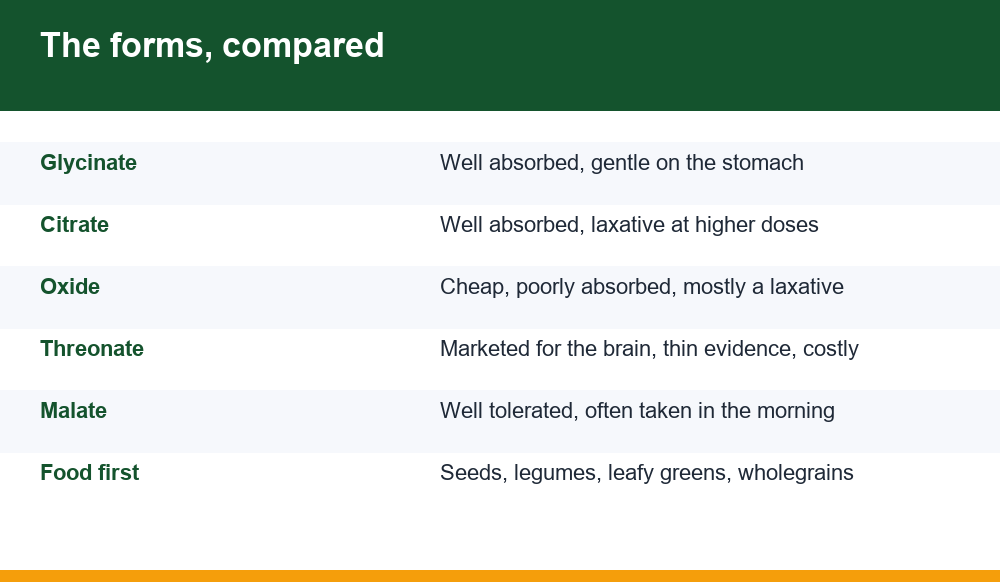
The form matters more than the headline milligram figure, because what the label states is usually the weight of the compound rather than of elemental magnesium, and absorption varies enormously between them.
| Form | Worth knowing |
|---|---|
| Glycinate | Well absorbed and gentle on digestion. Glycine itself has some calming association. The usual first choice for evening use. |
| Citrate | Well absorbed and inexpensive, but draws water into the bowel, so higher doses loosen stools. |
| Oxide | Cheap and very common because it is cheap. Poorly absorbed, and works mainly as a laxative. |
| Threonate | Heavily marketed on crossing into the brain. Human evidence is thin and it costs several times the alternatives. |
| Malate | Well tolerated, often suggested for daytime use rather than night. |
If a supermarket own-brand lists magnesium oxide and a high number, most of that number is passing through you. Glycinate is the sensible default for this purpose.
Dose, timing and the usual mistake
Typical supplemental doses used in sleep studies fall in the range of roughly 200 to 400mg of elemental magnesium in the evening. Starting at the lower end and staying there for a fortnight is more sensible than starting high, because digestive side effects are the main reason people abandon it.
The usual mistake is reading the front of the box. A capsule stating 500mg of magnesium glycinate contains far less elemental magnesium than that, because most of the weight is the glycine. The figure you want is on the back, and a product that does not state it clearly is telling you something.
Take it an hour or two before bed with a little food. Give it two to four weeks before deciding, since this is a case of topping up a store rather than taking a sedative, and judging it after two nights is the other common error.
Who should be careful
In healthy people, excess magnesium from supplements is mostly excreted by the kidneys, and the usual consequence of too much is digestive rather than dangerous. That changes when the kidneys are not working normally.
Anyone with reduced kidney function should not supplement magnesium without medical advice, because the clearance mechanism is the thing that is impaired. Magnesium also interacts with several common medications, including some antibiotics and thyroid medication, where it can reduce absorption if taken at the same time. Spacing doses by a few hours usually resolves that, but it is a conversation for a pharmacist rather than a guess.
If sleep problems are severe, long-running, or come with loud snoring and daytime exhaustion, the useful step is a proper assessment rather than a supplement. Sleep apnoea is common, frequently missed, and does not respond to minerals.
Getting it from food first
Food is the better route where it is realistic, because it arrives with fibre, potassium and the rest of the package, and because a diet containing these things is usually improving sleep by several routes at once.
The richest everyday sources are pumpkin seeds, almonds, cashews, spinach, black beans, edamame, dark chocolate, wholegrains and oily fish. A handful of pumpkin seeds carries a meaningful share of a day’s requirement, which surprises people who assumed supplementation was the only practical option.
The reason intakes have fallen is mostly refining. White flour and white rice lose a large proportion of their magnesium in processing, so a diet built on refined carbohydrates can be adequate in calories and short on this particular mineral.
Where it sits among the alternatives
It helps to place magnesium for sleep next to the other things people reach for, because the choice is rarely between a supplement and nothing.
Melatonin is a different kind of intervention. It is a timing signal rather than a sedative, which makes it genuinely useful for jet lag and for a body clock that has drifted late, and much less useful for someone who simply cannot switch off at a normal bedtime. Taking it nightly for ordinary insomnia is common and not well supported.
Valerian and similar herbal preparations have a long traditional record and a thin and inconsistent trial record. Some people find them helpful; the studies have not reliably separated that from expectation.
Against that background magnesium is unusual in having a plausible mechanism, a cheap price, a known safety profile in healthy people, and a clearly identifiable group most likely to benefit, namely those whose intake is low. That combination is why it is worth trying before most of the alternatives, and also why the honest expectation should stay modest.
What outperforms all of them, consistently and by a wide margin, is a fixed wake time. It is free, it is dull, and it is the single change most likely to improve a difficult sleeper’s nights. Supplements work best as something added to that, not as a replacement for it.
What magnesium for sleep realistically does
People who benefit tend to describe falling asleep a little faster and waking less, rather than anything dramatic. If you were expecting to be knocked out, that is not what this does, and a product promising it is overselling.
It also will not outrun the basics. A bedroom that is too warm, caffeine at four in the afternoon, an inconsistent wake time or a screen held close to the face at midnight will each undo more than a supplement adds. Magnesium is worth trying after those are in order, not instead of them.
Used that way it is a reasonable, cheap and low-risk experiment with a plausible mechanism behind it. Used as a substitute for a sleep routine, it joins the long list of things people take while the actual problem goes unaddressed. If a warm drink is part of your wind-down, our notes on herbal teas for sleep cover what those can and cannot do alongside it.
A final note on buying it. This is a supplement category with wide variation in quality and very little of it visible on the shelf, so the things worth checking are dull ones: that the label states elemental magnesium rather than compound weight, that the form is named rather than hidden behind a proprietary blend, and that the dose per serving is what you think it is rather than per three capsules. Independent testing marks are a reasonable tie-breaker between two otherwise similar products.
And if a month of consistent use changes nothing, stop. There is no benefit to continuing a supplement that is not doing anything, and persisting with one is often what stops somebody addressing the thing that would have worked.
Frequently Asked Questions
Which form of magnesium is best for sleep?
Glycinate is the usual first choice: well absorbed, gentle on digestion, and the glycine component has its own calming association. Citrate is a reasonable cheaper option but loosens stools at higher doses. Oxide is poorly absorbed and works mainly as a laxative.
How long before bed should I take it?
An hour or two before bed, with a little food to reduce the chance of stomach upset. More importantly, give it two to four weeks before judging it. This works by topping up a store rather than acting as a sedative, so a single night tells you very little.
Can you take too much magnesium?
From supplements, the first sign of too much is usually loose stools rather than anything serious, because healthy kidneys clear the excess. That safeguard does not apply if kidney function is reduced, and anyone in that position should not supplement without medical advice.
Does magnesium help with restless legs at night?
It may, particularly where intake is low, since magnesium is involved in muscle relaxation and deficiency is associated with cramping and restlessness. The evidence is not strong enough to call it a treatment, and persistent restless legs is worth having looked at properly.
Is it better to get magnesium from food?
Where it is realistic, yes. Pumpkin seeds, almonds, spinach, black beans, wholegrains and dark chocolate are all good sources, and they bring fibre and potassium with them. Supplements make most sense when diet cannot be changed easily or intake is clearly low.