
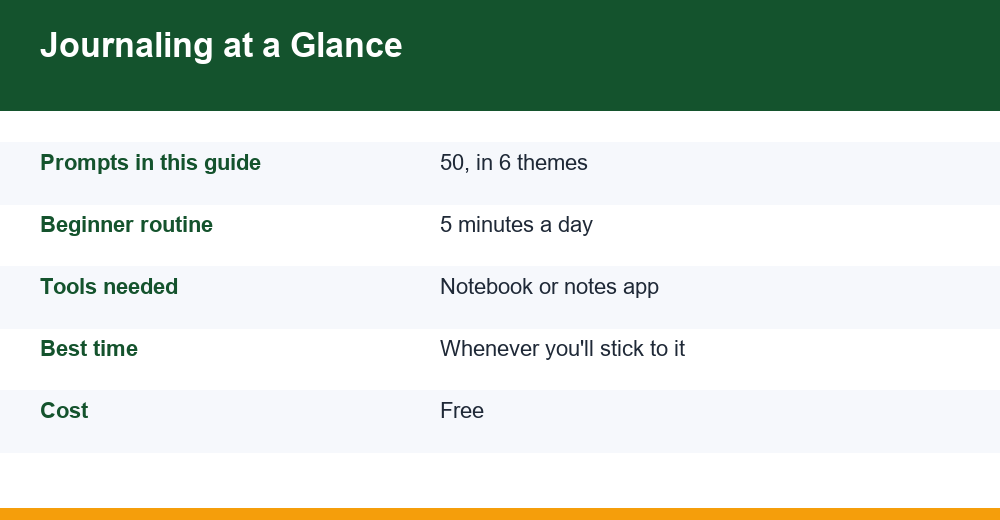
These wellness journal prompts are a free, organised bank of questions you can open any day and answer in a few minutes, no printable or subscription required. They are grouped by theme, so you can pick what fits your day: a restless night, a stressful week, a meal that left you flat, or simply wanting to notice what went right. Below you will also find a 5-minute routine for beginners and straight answers on timing, length and what the research says.
Table of Contents
What Should You Write in a Wellness Journal?
A wellness journal is not a diary of everything that happened. It is a short, regular check-in on how you are actually doing: body, mood, sleep, energy and the habits that feed them. Think of it as a notebook of observations rather than a place for polished writing.
Most useful entries cover three things: what you noticed, what you felt, and one small thing you might try next. That last part matters. Reflection without a next step can turn into rumination, while a single tiny action keeps the page practical.
If you are unsure where to begin, these are the areas most people find worth tracking:
- Sleep: how long, how well, and what happened before bed
- Stress: what triggered it, where you felt it, what helped
- Mood and energy: a quick 1-10 rating and a word or two of context
- Food and drink: not calorie counting, just how meals made you feel
- Movement and body: tension, aches, restlessness or ease
- Connection: who you spoke to and how it left you
You do not need to cover all of them every day. Good wellness journal prompts simply point your attention at one area at a time, which is why the bank below is grouped by theme instead of being one long list.
How to Start Journaling for Self-Care: A 5-Minute Routine
The biggest reason journaling habits fail is that people start too big. A full page every morning sounds lovely in week one and feels like homework by week three. Start with a routine so short it is almost impossible to skip.
Here is a 5-minute routine that works on paper or in a notes app:
- Minute 1 – Arrive. Take three slow breaths. Write the date and a 1-10 rating for energy and mood.
- Minute 2 – Check in. Write one sentence on how your body feels right now.
- Minutes 3-4 – One prompt. Pick a single question from the theme that fits today and answer it in a few lines.
- Minute 5 – One small step. Write one thing you will do in the next 24 hours, however small: a glass of water, a ten-minute walk, an earlier bedtime.
The breathing at the start is borrowed from simple mindfulness practices. It helps you shift from doing to noticing before you write, which tends to make the entry more honest and less rushed.
Set yourself up to succeed
- Keep the journal where you will see it: on the pillow, next to the kettle, or pinned on your phone’s home screen.
- Attach it to an existing habit, such as your first coffee or brushing your teeth at night.
- Allow bullet points and half sentences. Nobody is grading this.
- If you miss a day, skip the guilt and just write today’s entry.
50 Wellness Journal Prompts, Grouped by Theme
Use these wellness journal prompts one at a time. Choose the theme that matches how you feel today, answer a single question, and close the notebook. Over a few weeks you will start to see patterns that a once-off reflection would miss.
Sleep (8 prompts)
- How rested do I feel this morning, from 1 to 10, and what might explain that number?
- What was I doing in the hour before bed last night?
- What thoughts kept me awake, or woke me up?
- What helped me fall asleep more easily recently?
- How much screen time did I have in the evening, and how did I feel afterwards?
- What would make my bedroom feel calmer tonight?
- When did I last feel genuinely well rested, and what was different then?
- What is one sleep habit I want to protect this week?
Stress (9 prompts)
- What is weighing on me most today, in one sentence?
- Where in my body do I notice stress right now?
- Which part of this situation can I influence, and which part can’t I?
- What is the smallest next step on the thing I’m avoiding?
- Who could I ask for help, and what exactly would I ask?
- What did I tell myself about this problem that might not be fully true?
- What has helped me get through a similar week before?
- If a friend described this situation to me, what would I tell them?
- What can I say no to, or postpone, this week?
Gratitude (8 prompts)
- What are three specific things that went well today?
- Who made my day a little easier, and how?
- What is something my body allowed me to do today?
- What small pleasure did I almost overlook?
- What is a recent problem that turned out better than I feared?
- Which place, object or routine do I appreciate more than I usually admit?
- What did I learn this week that I’m glad to know?
- What is one thing about today I’d like to remember a year from now?
Food and mood (8 prompts)
- How did I feel about an hour after my main meal today?
- Did I eat when I was hungry, or for another reason, such as boredom, stress or habit?
- Which meal this week left me feeling steady and satisfied?
- How much water did I drink, and did I notice any difference?
- How did caffeine or alcohol affect my mood or sleep this week?
- What is one simple meal I enjoy that also makes me feel good?
- When did I last eat slowly, without a screen, and what was that like?
- What is one small, kind change I could make to tomorrow’s food?
Body check-in (9 prompts)
- Scanning from head to toe, where do I feel tight, and where do I feel at ease?
- How is my posture right now, and what happens if I soften my shoulders?
- How did I move my body today, and how did it feel?
- What is my energy doing: steady, crashing, buzzing or flat?
- Is there a recurring ache I keep ignoring?
- When did I last spend time outdoors, and how did my body respond?
- What does my body seem to be asking for right now: rest, movement, food, water or company?
- How has my breathing been today: shallow, held or relaxed?
- What is one way I can look after my body tomorrow?
Evening wind-down (8 prompts)
- What are the tasks I need to remember for tomorrow, so I can stop holding them in my head?
- What went better today than I expected?
- What is one thing I’m ready to let go of from today?
- What do I need in order to rest well tonight?
- Which conversation or moment today am I still replaying, and why?
- What did I do today that I’m quietly proud of?
- How do I want to feel when I wake up tomorrow?
- If today had a title, what would it be?
That is 50 prompts. If a question brings up something heavy, it is fine to stop, switch to a gratitude or body prompt, or simply close the notebook. The aim is support, not digging.
Good Journal Prompts for Beginners
Beginners do best with prompts that are concrete and quick to answer. Open questions such as “Who am I?” can feel paralysing on day one. Questions about today, your body or one specific event are easier to start with and build confidence.
Here is a starter week that pulls from the bank above. Each day takes about five minutes:
| Day | Theme | Prompt | Why it works for beginners |
|---|---|---|---|
| Monday | Body check-in | Where do I feel tight, and where do I feel at ease? | Anchors you in the present, no backstory needed |
| Tuesday | Gratitude | What are three specific things that went well today? | Easy to answer, gently positive |
| Wednesday | Sleep | How rested do I feel, 1-10, and why? | Starts building useful data |
| Thursday | Stress | What is weighing on me most, in one sentence? | Limits length, prevents spiralling |
| Friday | Food and mood | How did I feel an hour after my main meal? | Links habits to feelings |
| Saturday | Evening wind-down | What went better today than I expected? | Ends the week on a balanced note |
| Sunday | Review | Reading back this week, what pattern do I notice? | Turns entries into insight |
After the first week, keep the wellness journal prompts that felt useful and drop those that did not. A personal shortlist of eight to ten questions is often more sustainable than a long list.
If mornings suit you better, the Monday to Wednesday prompts slot neatly into a morning routine for wellness, alongside water, light and a little movement.
How Long Should You Journal Each Day?
There is no official ideal duration. Studies on journaling have used quite different formats, and the honest answer is that the right length is the one you will keep doing. For most people starting out, five to ten minutes is plenty.
Some research gives useful reference points. A 2018 trial on positive affect journaling asked participants to write for 15 minutes, three days a week, for 12 weeks. A 2018 sleep-lab study used just five minutes of writing before bed, and the CDC suggests setting aside 10 to 15 minutes a week for a gratitude list. All are short commitments, which suggests that consistency matters more than marathon sessions.
| Time available | What to do | Best suited to |
|---|---|---|
| 1-2 minutes | Mood and energy ratings plus one sentence | Busy days, keeping the streak alive |
| 5 minutes | The 5-minute routine with one prompt | Beginners, daily habit |
| 10-15 minutes | Two prompts from different themes | Working through a stressful period |
| 20+ minutes | Free writing or a weekly review | Weekends, bigger decisions |
Notice also how you feel after writing. If longer sessions leave you more wound up than when you started, shorten them and lean on prompts that end with a small action.
Is It Better to Journal in the Morning or at Night?
Both work; they simply do different jobs. Morning journaling tends to be about intention: how you want the day to go and what you need. Evening journaling is better for processing: clearing your head and closing the day.
| Morning | Night | |
|---|---|---|
| Main purpose | Setting intentions, planning | Processing, unloading, winding down |
| Best themes | Body check-in, sleep review, food plans | Gratitude, stress, evening wind-down |
| Common pitfall | Rushing because of the clock | Writing about worries until you feel more alert |
| Good fit if you | Wake up clear-headed | Lie awake replaying the day |
If your main goal is better sleep, evening has an edge, especially for one specific type of writing. In a 2018 Baylor University study of 57 young adults, published in the Journal of Experimental Psychology: General and measured with overnight polysomnography, people who spent five minutes writing a to-do list for the coming days fell asleep faster than those who wrote about tasks they had already completed. The more specific the list, the quicker they tended to drift off. It was a single-night lab study, so treat it as promising rather than proven.
A practical compromise: a one-minute rating in the morning and a short wind-down prompt at night. Try each for a week and keep whichever you actually look forward to.
Does Journaling Help With Stress and Sleep?
For many people, yes, though it is a support rather than a treatment. The CDC notes that writing about your feelings can help you express and understand them, see a situation from a new angle and work through problems more constructively; its guide to improving emotional well-being also suggests a weekly gratitude practice.
The research picture is encouraging but modest:
- Stress and anxiety: a preliminary randomised trial published in JMIR Mental Health in 2018 assigned 70 adults with medical conditions and elevated anxiety to web-based positive affect journaling or usual care. Journaling was linked with lower mental distress overall, and with fewer anxiety and depressive symptoms after the first month.
- Sleep onset: the Baylor University sleep-lab study described above found that writing a specific to-do list before bed helped young adults fall asleep faster, by roughly nine minutes on average, than writing about completed tasks.
- Limits: both studies were small, and journaling does not suit everyone. Some people find that writing about problems keeps them stuck in them.
Why might it help? Writing gives a worry a defined shape and a place to live outside your head. Pairing journaling with body-based techniques, such as slow breathing or the approaches in our guide to nervous system regulation, can make the calming effect more noticeable, because you are working on both thoughts and physical tension.
When journaling is not enough
This blog shares general wellness information, not medical advice. If stress, low mood or poor sleep last for several weeks, affect your work or relationships, or come with thoughts of harming yourself, speak to a doctor or a qualified mental health professional. A journal can be a helpful record to bring to that appointment.
Keeping the Habit Going
Most journals are abandoned within weeks, usually because the routine grew too long or the entries started to feel repetitive. A few small adjustments keep it fresh without adding effort.
- Rotate themes weekly. Focus on sleep one week and food and mood the next, so the questions stay interesting.
- Do a monthly review. Read back over four weeks and note one pattern, one win and one change to try.
- Use a two-minute rule. On bad days, the ratings plus one sentence still count.
- Mix formats. Lists, ticks, a quick sketch or a single word can all be an entry.
- Keep it private. Honest entries are more useful than tidy ones, so store the journal where you feel safe writing freely.
Bookmark this page and return to the wellness journal prompts whenever your current questions start to feel stale. Over time, the journal becomes less about answering prompts and more about a steady habit of noticing, which is where much of its value lies.
Frequently Asked Questions
What should I write in a wellness journal?
Write short, honest check-ins on sleep, stress, mood, energy, food and how your body feels. A useful entry notes what you observed, how you felt and one small step for the next 24 hours. You do not need to cover every area daily; pick one theme and answer a single prompt.
How long should I journal each day?
Five to ten minutes is enough for most beginners. Studies have used short formats, such as five minutes before bed or 15 minutes three times a week. Consistency matters more than length, so choose a duration you can keep up, even if that is two minutes on busy days.
Is it better to journal in the morning or at night?
Neither is better overall. Morning journaling suits planning and setting intentions, while evening journaling suits unloading the day and winding down. If sleep is your main concern, a short evening entry, such as writing tomorrow’s to-do list, may help you switch off before bed.
Do wellness journal prompts help with stress?
They can. The CDC says writing about your feelings can help you understand and cope with them, and a small 2018 trial linked regular positive journaling with lower distress. Prompts give a worry a clear shape and a next step. If stress lasts for weeks or affects daily life, speak to a doctor or mental health professional.