A good herbal tincture recipe needs only three things: a plant you know well, a suitable solvent and a few weeks of patience. This guide walks you through both the relaxed folk method and the more precise weight-to-volume approach, with ratio and alcohol-strength tables you can actually work from. You will also find an alcohol-free glycerite option and the safety notes that many recipe pages leave out.
Table of Contents
What a Tincture Is and How It Differs From Tea
A tincture is a concentrated liquid extract made by soaking plant material in a solvent, usually a mix of ethanol and water. Herbalists call that liquid the menstruum, and the soaking process maceration. Over several weeks, the solvent draws out compounds from leaves, flowers, roots or seeds, and the spent plant is then strained off.
Tea works on the same principle but with hot water over minutes rather than alcohol over weeks. If you are new to working with herbs, it is worth getting comfortable with brewing a proper herbal infusion first. You will learn how each plant smells, tastes and behaves, which makes judging a tincture much easier later.
The main practical differences come down to strength, convenience and keeping quality:
- Concentration: a tincture is taken in drops or small dropperfuls, not by the cup.
- Shelf life: a properly made alcohol tincture keeps for years, while brewed tea spoils within a day or two.
- Extraction range: alcohol pulls out resins and some constituents that water dissolves poorly, while water handles others better. That is why most recipes use a blend of the two.
- Portability: a small dropper bottle travels far more easily than a bag of loose herbs.
What You Need for an Herbal Tincture Recipe
You do not need specialist equipment. Most of what a simple herbal tincture recipe calls for is probably already in your kitchen. A digital scale and a measuring jug are the only items worth buying if you plan to try the weight-to-volume method.
| Item | Why it matters | Notes |
|---|---|---|
| Glass jar with tight lid | Holds the herb and solvent for weeks | Mason or clip-top jars work well; avoid plastic |
| Herb (dried or fresh) | Your source material | Buy from a reputable supplier with a clear botanical name |
| Drinking alcohol | Extracts and preserves | Vodka or high-proof grain spirit; never rubbing alcohol |
| Digital kitchen scale | Weighs herb accurately | Needed for weight-to-volume ratios |
| Measuring jug | Measures solvent volume | Millilitre markings make the maths easier |
| Cheesecloth or muslin | Strains out plant material | A fine sieve helps as a first pass |
| Amber dropper bottles | Store the finished extract | Dark glass limits light exposure |
| Labels and a pen | Records what is in the bottle | Do this on day one, not at the end |
Clean everything with hot soapy water and dry it thoroughly before you start. Leftover water in a jar slightly dilutes your solvent, which matters most when working with fresh, juicy plants.
Should You Use Fresh or Dried Herbs?
Both work, but they behave differently in the jar. The key factor is water content. Fresh plants carry a lot of moisture that leaches into the menstruum and lowers its alcohol percentage. Dried herbs bring almost no water, so you have more control over the final strength.
When fresh herbs make sense
Some herbalists prefer fresh material for plants whose aromatic character fades on drying, such as lemon balm or freshly picked flowers. If you grow your own, fresh tinctures let you capture a harvest on the day. The trade-off is that you need high-proof alcohol so the finished extract stays above a reliable preservative level once the plant’s water has mixed in.
When dried herbs make sense
Dried herbs are easier to buy, weigh and store, and they are the standard starting point for beginners. Nettle is a good example: many people already keep dried leaf for brewing, and if you have read about what nettle tea offers, you can use the same dried leaf for a tincture. Chop or coarsely grind dried roots and barks so the solvent can reach more surface area.
- Fresh herbs: use a 1:2 ratio with roughly 95% alcohol.
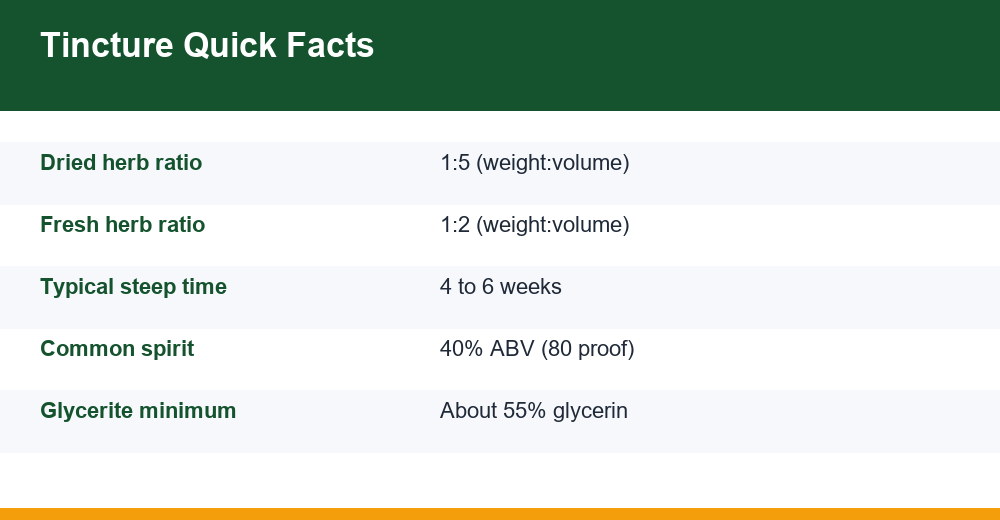
- Dried herbs: use a 1:5 ratio with roughly 40% to 60% alcohol, depending on the plant.
- Dense material such as seeds and roots should be ground; fluffy flowers need more liquid to stay covered.
Herb-to-Alcohol Ratios and the Best Alcohol to Use
Ratios in tincture-making are written as weight to volume. A 1:5 ratio means 1 gram of herb for every 5 millilitres of liquid. So 20 g of dried herb would go into 100 mL of menstruum. A 1:2 fresh tincture would use 50 g of fresh herb in 100 mL.
These are long-standing herbalist conventions rather than a regulated standard, so treat them as reliable starting points that you can adjust with experience.
| Herb type | Ratio (w:v) | Approx. alcohol strength | Example quantities |
|---|---|---|---|
| Dried leaf or flower | 1:5 | 40% to 60% | 20 g herb + 100 mL |
| Dried root, bark or seed (ground) | 1:5 | 50% to 65% | 40 g herb + 200 mL |
| Very light dried flowers | 1:5 or more liquid | 40% to 60% | Add liquid until covered |
| Fresh leaf or flower | 1:2 | About 95% | 50 g herb + 100 mL |
| Fresh root (chopped finely) | 1:2 | About 95% | 100 g herb + 200 mL |
What alcohol is best for making tinctures?
Use only drinkable ethanol. For most dried herbs, a plain unflavoured vodka at 40% ABV (80 proof in the US system) is the easiest choice and widely available. To convert US proof to percentage, divide by two. If your plant needs more alcohol, or you are working with fresh herbs, a neutral grain spirit around 95% ABV (190 proof) is the usual option where it is legally sold.
You can blend high-proof spirit with distilled water to hit a target. For example, about 63 mL of 95% spirit topped up to 100 mL with water gives roughly 60% alcohol (60 divided by 95 is about 0.63). Brandy and rum work too, but they add flavour and colour.
- Never use rubbing alcohol (isopropyl), methylated spirits or denatured alcohol. These are toxic to drink.
- Avoid flavoured spirits, which add sugar and aromas that muddy the result.
- Below roughly 20% to 25% alcohol, preservation becomes unreliable for most herbs.
The 7-Step Herbal Tincture Recipe
This herbal tincture recipe gives you two routes. The folk method uses no scale: you fill a jar by eye and cover the herb with alcohol. The weight-to-volume method uses measured quantities from the table above, which makes batches repeatable. The steps are the same either way.
- Prepare the herb. Chop fresh plants finely or crumble dried leaf. Grind roots, barks and seeds coarsely. Smaller pieces mean better contact with the solvent.
- Measure or fill. For weight-to-volume, weigh your herb and calculate the liquid (1:5 dried, 1:2 fresh). For the folk method, fill a jar about half full with dried herb or three-quarters full with fresh herb.
- Add the menstruum. Pour alcohol over the herb. With the folk method, keep going until the plant is covered by about 2 to 3 cm (roughly an inch). Dried herb swells, so check again after a day and top up if needed.
- Seal and label. Close the lid tightly and label the jar with the plant name, part used, ratio, alcohol percentage and start date.
- Steep and shake. Store the jar somewhere cool and dark. Shake it once a day, or as often as you remember, for 4 to 6 weeks.
- Strain and press. Pour through a sieve lined with cheesecloth or muslin, then gather the cloth and squeeze hard. Much of the extract stays trapped in the plant, so pressing improves your yield.
- Bottle and rest. Funnel the liquid into amber bottles, label them, and leave them for a day or two. Any fine sediment settles and can be left behind when you decant.
How long should a tincture steep?
Four to six weeks is the common window for most home tinctures. Light leaves and flowers often give a strong-smelling extract within two weeks, while tough roots and barks benefit from the full six. Leaving a jar longer than six weeks rarely causes harm if the plant stays covered, but the gains are small.
A useful habit is to note the colour and smell weekly on your label. After a few batches you will know when a particular herb has given up most of what it has.
Can You Make a Tincture Without Alcohol?
Yes. An alcohol-free extract made with vegetable glycerin is called a glycerite. It suits households that avoid alcohol for religious, health or recovery reasons, and many people find the sweet taste easier to take. Strictly speaking, some herbalists reserve the word tincture for alcohol extracts, but the method is similar.
Glycerin needs some water to extract well, yet too much water lets mould and microbes grow. Herbal teaching sources commonly give at least 55% glycerin in the finished glycerite as the minimum, and several recommend 60% to 75% for a safer margin. For dried herbs, a mix of about 3 parts glycerin to 1 part distilled water (75% glycerin) is a widely used starting blend.
- Mix 75 mL food-grade vegetable glycerin with 25 mL distilled water.
- Use roughly 1 part dried herb to 4 or 5 parts of this mixture by weight to volume.
- For fresh herbs, use undiluted glycerin, since the plant supplies the water.
- Steep 4 to 6 weeks in a cool, dark place, shaking regularly.
- Strain, press and bottle exactly as for an alcohol tincture.
| Feature | Alcohol tincture | Glycerite |
|---|---|---|
| Taste | Sharp, warming | Sweet, mild |
| Extraction range | Broad | Narrower; resins extract poorly |
| Approximate shelf life | Several years | About 1 to 2 years |
| Suits alcohol-free homes | No | Yes |
| Ease of making | Simple | Simple, but watch water content |
Apple cider vinegar is another alcohol-free option, often used for mineral-rich leaves. Vinegar extracts keep for a shorter time than alcohol tinctures and are best stored in the fridge.
Labelling, Storage and How Long Tinctures Last
A label is not a nice extra. Once two amber bottles sit side by side, you cannot tell them apart by look alone. Write the label before you bottle so nothing gets mixed up.
- Common name and botanical (Latin) name
- Plant part used and whether fresh or dried
- Ratio and alcohol or glycerin percentage
- Date started and date strained
- A clear note such as “Keep out of reach of children”
How long do homemade tinctures last?
Shelf life depends mostly on the solvent. Alcohol-based tinctures stored in dark glass away from heat and light are generally considered stable for several years; many herbalists suggest using them within about three to five years for best quality, though this is an approximate guide rather than a tested figure. Glycerites are usually given about one to two years.
Store bottles in a cupboard rather than on a sunny windowsill or above the stove, since light and warmth gradually break down plant constituents. Discard any extract that smells off, grows mould, turns cloudy in a way it did not before, or tastes clearly wrong. With glycerites and vinegar extracts, be stricter, as they preserve less strongly than high-proof alcohol.
Safety Notes Most Recipe Blogs Skip
Following an herbal tincture recipe is straightforward. Knowing whether a particular herb is right for you is the harder part. Natural does not automatically mean safe, and a concentrated extract can deliver more of a plant’s active constituents than a cup of tea.
The US National Center for Complementary and Integrative Health points out that some supplements can interact with medicines, have side effects of their own, or affect bleeding and anaesthesia during surgery. Its guide to using dietary supplements wisely is a sensible read before you start taking any homemade extract regularly.
- Identify plants with certainty. Several harmless-looking wild plants have toxic lookalikes. If you are not 100% sure, do not harvest it.
- Check medication interactions. Herbs can affect how drugs are absorbed and broken down. Speak to a pharmacist or doctor if you take blood thinners, antidepressants, heart medication or any regular prescription.
- Pregnancy and breastfeeding: many herbal products have not been tested in pregnant or nursing women. Get professional advice first.
- Children: alcohol tinctures are generally not suitable for young children. A glycerite is often preferred, but still ask a qualified practitioner about the herb and amount.
- Alcohol content: even a few drops contain alcohol. This matters for anyone in recovery, with liver disease, or taking medicines that react with alcohol.
- Before surgery: tell your care team about every herbal product you use, as some can affect bleeding or anaesthesia.
If you are interested in calming plants, our overview of herbs people use for anxiety covers which ones have research behind them. Persistent worry, low mood or sleep problems deserve a conversation with a health professional, not only a home remedy.
Start with one herb at a time and a small amount, so you can notice how you respond. Stop and seek advice if you notice side effects. This blog shares general wellness information and is not a substitute for medical advice. Any herbal tincture recipe is best treated as a complement to, never a replacement for, proven treatment and professional care.
Frequently Asked Questions
What is the ratio of herbs to alcohol for a tincture?
Most home herbalists use a weight-to-volume ratio of 1:5 for dried herbs, meaning 1 gram of herb to 5 millilitres of liquid, and 1:2 for fresh herbs. For example, 20 g of dried leaf goes into 100 mL of alcohol. The folk method skips weighing: fill a jar partly with herb and cover it with alcohol by about 2 to 3 cm.
What alcohol is best for making tinctures?
Plain, unflavoured vodka at 40% ABV (80 proof) suits most dried herbs and is easy to find. For fresh herbs or resinous plants, a neutral grain spirit around 95% ABV is often used where legally available, sometimes diluted with distilled water. Never use rubbing alcohol, methylated spirits or denatured alcohol, as these are toxic to drink.
How long should a tincture steep?
Most tinctures steep for 4 to 6 weeks in a cool, dark place, with the jar shaken once a day. Soft leaves and flowers often extract well within two to four weeks, while dense roots, barks and seeds benefit from the full six weeks. Make sure the plant material stays fully covered by liquid throughout.
How long do homemade tinctures last?
Alcohol-based tinctures kept in amber glass, away from heat and light, generally stay usable for several years; three to five years is a common approximate guide. Glycerites usually last about one to two years, and vinegar extracts less. Discard any extract that develops mould, an off smell or unusual cloudiness.