
Waking up at 3am and lying there wide awake is one of the most common sleep complaints, and it is rarely as mysterious as it feels in the dark. Most people wake briefly several times a night; the trouble starts when your mind switches on and refuses to switch off again. This guide covers the usual causes, a practical protocol for the middle of the night, and the signs that mean it is time to talk to a clinician.
Table of Contents
Why Do I Keep Waking Up at 3am?
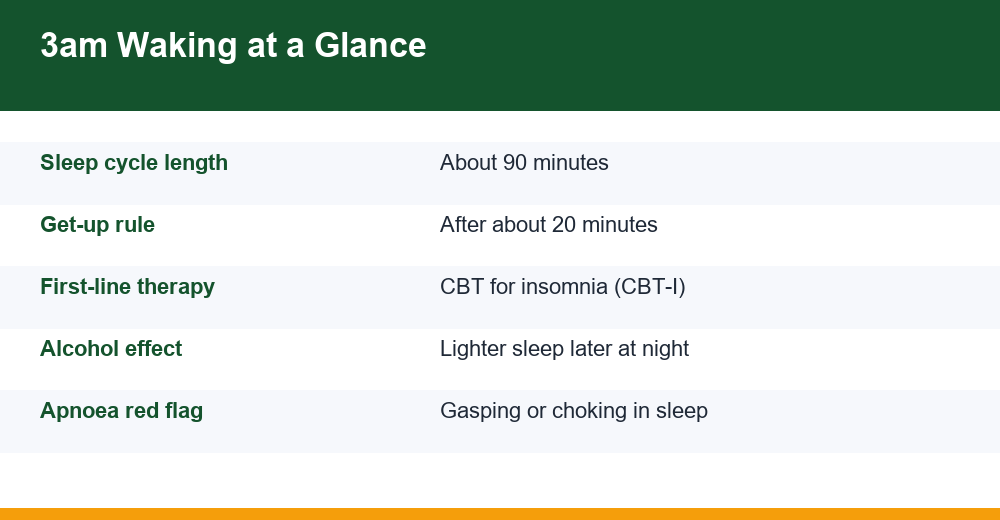
Sleep is not one long, even block. Your brain moves through cycles of light sleep, deep sleep and REM (dreaming) sleep, each lasting roughly 90 minutes, and most adults run through four to six of them a night. At the end of each cycle you surface close to wakefulness. Usually you roll over and drift off without remembering it.
The structure of those cycles changes as the night goes on. Deep, restorative sleep is concentrated in the first half of the night. The second half contains more light sleep and more REM sleep, both of which are easier to wake from. If you went to bed around 11pm, the 3am window falls right when your sleep has become lighter and much of your deep-sleep pressure has been paid off.
That is why waking up at 3am is so common: it is the point where a small nudge, such as a noise, a full bladder, a hot room or a worried thought, can tip you fully awake. The waking itself is usually normal. What turns it into a problem is the arousal that follows: checking the time, calculating hours left until the alarm, and replaying tomorrow’s to-do list.
Why it feels worse at night
In the small hours your body temperature is near its lowest point and your thinking is foggier, so worries tend to feel bigger and less solvable than they would at 10am. Knowing this helps. A thought that feels urgent in the middle of the night is usually a thought that can wait until breakfast.
The Most Common Causes at a Glance
Early-hours waking usually has more than one contributor. Use the table below to spot the patterns that match your nights, then focus on the one or two that seem most likely.
| Cause | Typical clue | What to try first |
|---|---|---|
| Stress and racing thoughts | Mind switches on instantly; worries loop | Wind-down routine, worry list before bed |
| Alcohol in the evening | Easy to fall asleep, then awake and alert later | Earlier, smaller drinks or alcohol-free nights |
| Acid reflux | Burning, coughing or sour taste when lying down | Earlier dinner, smaller portions, raise head of bed |
| Perimenopause and menopause | Night sweats, hot flushes, waking damp | Cooler room, layered bedding, talk to a GP |
| Needing to urinate | Waking with a full bladder | Reduce fluids in the last hours before bed |
| Irregular schedule | Bedtime and wake time vary by hours | Fixed wake time, morning daylight |
| Sleep apnoea | Loud snoring, gasping, tired all day | See a doctor for assessment |
| Low mood or depression | Very early waking with low mood | Talk to a GP or mental health professional |
Ageing plays a part too. Sleep generally becomes lighter and more fragmented as we get older, so older adults tend to wake more often during the night. That is a normal change, but it still deserves attention if it leaves you exhausted during the day.
Is a 3am Wake-Up a Sign of Stress?
Often, yes, though not always in the way people assume. Cortisol, the hormone linked to alertness, is at its lowest in the first half of the night, then gradually climbs towards morning and peaks roughly 30 to 45 minutes after you wake. That rise is part of a healthy circadian rhythm, not a malfunction.
The popular claim that a cortisol spike is what jolts you awake at 3am is an oversimplification. The evidence on whether cortisol directly triggers the waking is mixed. What is better supported is that stress raises your general level of physical and mental arousal, so a normal brief awakening is more likely to become a full one, and harder to come back from.
Signs stress is the main driver
- You wake with a specific worry already in your head, often about work, money or family.
- Your heart is beating faster than usual and your muscles feel tense.
- The wake-ups cluster around busy or difficult periods and ease on holidays.
- You find yourself mentally rehearsing conversations or tasks.
If this sounds familiar, the fix lies partly in the evening, not just in the small hours. A short worry list written an hour before bed, with one next step beside each item, gives your brain permission to park those thoughts. Some people also find a warm, caffeine-free drink helps signal the end of the day; our guide to herbal teas for sleep covers the gentler options and what the evidence says about them.
Alcohol, Reflux and Hormonal Changes
Can alcohol cause you to wake up at night?
Yes, and it is one of the most underrated causes. Alcohol is sedating at first, so it can help you nod off. As your body processes it over the following hours, that sedative effect wears off and research shows sleep in the second half of the night becomes lighter and more broken, with more wakefulness. Many people notice they wake in the early hours feeling oddly alert after an evening drink.
Alcohol is also a diuretic, so it can send you to the bathroom, and it relaxes throat muscles, which can make snoring and breathing problems worse. Standard sleep advice is to cut down on alcohol, especially in the hours before bed. A simple experiment is to go alcohol-free for two weeks and keep a note of how often you wake.
Acid reflux
Lying flat makes it easier for stomach acid to travel upwards, especially after a large or late meal. Reflux at night can show up as burning in the chest, coughing, a sour taste or simply unexplained waking. Eating dinner earlier, keeping evening portions moderate, cutting back on trigger foods such as spicy or fatty dishes, and raising the head of the bed slightly can all help. Persistent symptoms are worth discussing with a pharmacist or doctor.
Perimenopause and menopause
Hot flushes and night sweats often begin in perimenopause, and they are a common reason for broken sleep at this stage of life. Waking hot and damp in the early hours is a strong clue. A cooler bedroom, breathable cotton or linen bedding, layers you can remove without fully waking, and a glass of water by the bed are sensible first steps. Effective medical treatments exist, so do raise it with a GP if it is affecting your sleep.
How to Fall Back Asleep After Waking Up at 3am
The goal at night is not to force sleep. Sleep cannot be forced; it arrives when arousal drops. Every step below is about lowering arousal and removing the things that keep it high.
- Do not check the clock. Turn it to face the wall and keep your phone out of reach. Knowing it is 3:17am starts the mental arithmetic that keeps you awake.
- Stay still and keep your eyes closed for a few minutes. Many awakenings resolve on their own if you do nothing at all.
- Slow your breathing. Breathe in gently through your nose for about four counts and out for about six. A longer out-breath helps shift the body towards a calmer state.
- Relax your body in sections. Starting at your feet, tense each muscle group lightly for a few seconds, then let it go, working up to your face and jaw.
- Give your mind a boring job. Try listing animals or foods for each letter of the alphabet, or picture a familiar walk in slow detail. Neutral, mildly absorbing tasks crowd out worry.
- Write the worry down. If a thought will not leave, jot it on a notepad by the bed, using dim light, and tell yourself you will deal with it in the morning.
- Fix the room. Kick off a layer if you are hot, use the toilet if you need to, and block noise with earplugs or a steady fan.
- Keep light dim and warm. If you need light, use the faintest lamp you have. Avoid overhead lights and screens, which signal daytime to your brain.
- Follow the 20-minute rule. If you feel more awake and frustrated after roughly 20 minutes, get up and do something quiet elsewhere until you feel sleepy (see the next section).
Notice what is missing from this list: scrolling, emails, news and lying there trying hard to sleep. Effort is the enemy here. Many people find that simply accepting the wake-up, telling themselves that resting quietly still has value, is what finally lets sleep return.
Should You Get Out of Bed If You Can’t Sleep?
If you have been awake for around 20 minutes and feel restless or annoyed, the answer is usually yes. This idea, often called stimulus control, is a core part of cognitive behavioural therapy for insomnia (CBT-I), which is the recommended first-line treatment for long-term insomnia. The aim is to stop your brain linking your bed with frustration and wakefulness.
The NHS Every Mind Matters sleep advice suggests that if you are still awake after around 20 minutes, you get up, sit somewhere comfortable with a relaxing activity, and go back to bed when you feel sleepy. Roughly 20 minutes is a guide, not a stopwatch target; since you are not watching the clock, go by how you feel.
What to do once you are up
- Sit somewhere comfortable in dim, warm light.
- Read something calm on paper, listen to quiet music or do a gentle puzzle.
- Avoid screens, snacks, work and anything you find exciting.
- Return to bed as soon as your eyelids feel heavy, even if that is only ten minutes later.
One caution: getting up in the dark carries a fall risk, particularly for older adults or anyone unsteady on their feet. In that case, a night light on the route and sitting up in bed with a calm activity can be a safer alternative.
Daytime Habits That Protect the Second Half of the Night
Most of the real progress against early-hours waking happens during the day. The second half of the night is fragile by nature, so the aim is to build strong, steady sleep pressure and a clear body clock.
- Keep a fixed wake time, including weekends. This is the single most powerful anchor for your body clock.
- Get daylight early. Ten to thirty minutes outside in the morning helps set your rhythm. Our guide to resetting your circadian rhythm explains how light timing works in more detail.
- Cut caffeine by early afternoon. Its effects can linger for many hours and lighten sleep even if you still fall asleep easily.
- Move your body most days, ideally earlier rather than in the hour before bed.
- Avoid long late naps, which reduce the sleep pressure you need to carry you through to morning.
- Front-load fluids so you drink more earlier in the day and less in the last couple of hours before bed.
Resist the urge to go to bed much earlier to make up for lost sleep. Spending extra hours in bed tends to spread sleep thinner and can make waking up at 3am more likely, not less.
What about supplements?
Magnesium is a popular evening supplement, and different forms are absorbed and tolerated differently. If you are considering it, our comparison of magnesium glycinate vs citrate sets out the differences. Evidence for supplements as a fix for night waking is limited, so treat them as a possible extra rather than a replacement for the habits above, and check with a pharmacist if you take other medicines.
When to See a Doctor About Night Waking
An occasional bad night needs no medical attention. Persistent waking up at 3am does deserve a conversation with a GP or other clinician, particularly if any of the following apply.
- You have tried improving your sleep habits for several weeks and nothing has changed.
- Poor sleep has gone on for months or is affecting your work, mood, driving or relationships.
- A partner notices pauses in your breathing, gasping, snorting or choking sounds, or very loud snoring.
- You feel very sleepy during the day, wake with headaches or struggle to concentrate.
- You wake very early with low mood, loss of interest, or feelings of hopelessness.
- You have night sweats you cannot explain, chest pain, or reflux that persists despite changes.
- You need to urinate several times a night on a regular basis.
Why sleep apnoea matters
Obstructive sleep apnoea is a condition in which breathing repeatedly stops and starts during sleep. Each pause can briefly wake you, though you may not remember it. Because the signs are hard to notice in yourself, a partner is often the first to spot them. It is treatable, and getting it assessed matters for both your energy and your long-term health.
If insomnia is the main issue, ask about CBT-I. It is available in person and through structured digital programmes, and it tends to produce longer-lasting results than sleeping tablets. If low mood or anxiety is part of the picture, mention it, because treating it often improves sleep as well. If you ever feel unsafe or have thoughts of harming yourself, seek urgent help straight away.
Frequently Asked Questions
Why do I keep waking up at 3am?
By around 3am most of your deep sleep is behind you, and sleep is lighter and easier to break. Stress, evening alcohol, reflux, night sweats, a full bladder or an irregular schedule can then tip a brief normal awakening into full wakefulness. Worrying about it makes the pattern stronger, which is why calm habits matter so much.
How do I fall back asleep after waking in the night?
Keep the clock out of sight, stay still, and breathe slowly with a longer out-breath. Relax your muscles one group at a time and give your mind a neutral task, like an alphabet list. If you feel more awake after about 20 minutes, get up, sit in dim light with something calm, and return when sleepy.
Can alcohol cause you to wake up at night?
Yes. Alcohol can help you fall asleep, but as your body processes it the sedative effect fades and sleep becomes lighter and more fragmented later in the night. It can also make you need the toilet and worsen snoring. Avoiding alcohol in the hours before bed often reduces early-hours waking noticeably.
When should I see a doctor about waking up at night?
See a GP if poor sleep lasts for weeks despite better habits, affects your daytime life, or comes with loud snoring, gasping or breathing pauses, heavy daytime sleepiness, low mood, unexplained night sweats or persistent reflux. These can point to treatable conditions such as sleep apnoea, depression or insomnia, which responds well to CBT-I.