Adaptogens are herbs and roots that people have long reached for to feel a little steadier when life turns stressful, and lately they have travelled from the herbalist’s shelf into everyday teas, powders and capsules. This friendly guide explains what they are, how they have traditionally been used, and — just as honestly — what today’s research can and cannot promise. Think of it as a calm place to start, not a prescription or a shopping list.
Table of Contents
What Are Adaptogens, Really?
The idea is older than the current trend suggests. The term adaptogen was coined in the 1940s by a Soviet scientist, Nikolai Lazarev, to describe substances believed to raise the body’s general resistance to stress. It has been questioned and refined many times since, yet the core notion has proved sticky: certain plants may help you weather pressure without knocking you flat or winding you up.
Herbalists and researchers generally look for three qualities before a plant earns the label:
- It is broadly non-toxic when taken at sensible, everyday amounts.
- It appears to help the body cope with physical, mental or environmental stress.
- It gently steers the body back toward balance, rather than over-stimulating or sedating it.
So adaptogens are best understood as quiet allies for resilience rather than quick fixes, and certainly not cures. Part of their modern appeal is simply that they promise support without the jolt of caffeine or the heaviness of a sedative. The concept has been debated and refined for decades, and there is still no single official definition that everyone in science agrees on.
It also helps to know what these plants are not. They are not stimulants that override tiredness, and they are not tranquillisers that switch feelings off. At their best they work in the background, softening the edges of a stressful stretch so you can rest, focus and recover a little more easily. Against that gentle promise, wild claims of overnight transformation are a useful warning sign.
How These Herbs Are Thought to Work
To understand the appeal, picture what long-term stress actually does. A response that should rise and then fall can get stuck in the ‘on’ position, leaving you wired, tired and frayed at once. The hope behind these plants is not to numb that system but to help it find its natural rhythm again.
Most of the science centres on the body’s built-in stress circuit, the HPA axis (short for hypothalamic-pituitary-adrenal axis). When you sense a threat, this chain of glands releases hormones, including cortisol, that prepare you for action. That surge is useful in short bursts and wearing when it never truly switches off.
The proposed idea is that these herbs behave like modulators rather than blunt switches. Instead of simply forcing cortisol down, they may help the stress response fire when it is needed and settle more smoothly afterwards, nudging the body toward its own balance.
A common comparison is a thermostat. A stimulant is like blasting the heating regardless of the room; an adaptogen is imagined more as a thermostat that responds to what is actually needed. It is an appealing picture — and a reminder that a tidy metaphor is not the same as proof in people. Much of this mechanism is still theory, drawn largely from laboratory and animal studies, so honest expectations matter.
The Best-Known Stress Herbs
A handful of plants dominate the conversation, each with its own personality and its own traditional home — from Ayurveda in India to the cold mountains of Scandinavia and Siberia.
| Herb | Traditional roots | Most studied for |
|---|---|---|
| Ashwagandha | Ayurvedic calming tonic | Stress, sleep, anxiety |
| Rhodiola | Nordic ‘golden root’ | Fatigue, low mood, focus |
| Holy basil (tulsi) | Sacred herb of India | Everyday stress, sleep |
| Asian ginseng | Traditional Chinese tonic | Energy, mental stamina |
| Schisandra | Chinese ‘five-flavour’ berry | Endurance, concentration |
Ashwagandha, sometimes called Indian ginseng or winter cherry, is the most talked-about of the group; in Ayurvedic tradition it is a grounding tonic, and modern interest focuses on calm and sleep. Rhodiola grows in cold, high places and has almost the opposite reputation — a subtle lift for tired minds and flagging energy.
Holy basil, or tulsi, is revered across India and often taken as a fragrant tea for the wear and tear of a busy day. Asian ginseng and schisandra round out the list, valued in traditional Chinese medicine for stamina and focus. A helpful rule of thumb: some plants lean energising while others lean calming, so one label can cover very different experiences.
Which one suits you is partly about matching a herb’s character to your own days. If you feel tired and foggy, an energising plant may appeal; if you feel tense and over-revved, a calming one might fit better. None of this is an exact science, and there is no shame in finding that a particular herb simply does nothing noticeable for you.
A few other plants crop up under the same banner. Eleuthero, once sold as Siberian ginseng, comes from the same research tradition, while maca, cordyceps and reishi mushrooms are often marketed this way too. The evidence for these is thinner still, so it is wise to treat bold claims with extra care and the same patient, one-at-a-time approach you would give any new herb.
What the Evidence Does and Doesn’t Show
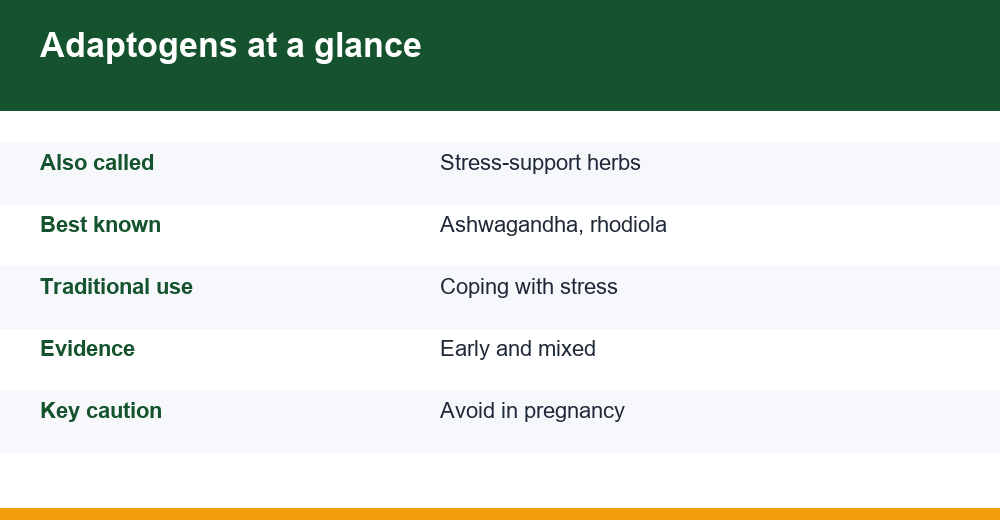
This is where an honest guide has to slow down. There is real, encouraging research on some of these herbs, but the overall evidence base is still early and mixed rather than settled science.
A few limits are worth remembering when you meet glowing headlines about adaptogens:
- Many trials are small and run for weeks rather than months or years.
- Some are funded by the companies selling the products being tested.
- Extracts, doses and preparations differ, so studies are hard to compare.
- Encouraging results tend to attract more attention than disappointing ones.
Individual response also varies widely. What feels wonderful for a friend may do little for you, and belief that something will help — the placebo effect — is a genuine, powerful part of any stress remedy. That does not make these herbs worthless; it simply means modest, patient expectations serve you better than miracle claims.
It is also worth ignoring the pressure to ‘test your cortisol’ with home kits before and after. A single reading tells you very little, cortisol swings naturally through the day, and chasing a number can create more anxiety than it soothes. A realistic win looks quiet: sleeping a touch better, feeling slightly less frazzled by small things.
Where does that leave us? Ashwagandha has some of the more consistent short-term findings for perceived stress and anxiety, while holy basil and rhodiola have smaller but promising bodies of work. Even so, these herbs do not cure anxiety, depression or any medical condition, and they should never replace care you genuinely need.
Forms, Teas and How People Use Them
One reason these botanicals feel so approachable is the sheer choice of formats. You will find them as capsules, loose powders, teas and liquid tinctures, and the right one usually comes down to taste, budget and routine.
- Capsules and tablets: convenient and consistent in dose, and easy to track.
- Powders: stirred into warm milk, smoothies or coffee — earthy, and easy to overdo.
- Teas and infusions: gentle and ritual-friendly, milder than concentrated extracts.
- Tinctures: liquid extracts taken by the drop, so follow the label closely.
If you choose an extract, you may see the word standardised on the label, meaning the active compounds are kept at a consistent level from batch to batch — a small sign of quality. Whatever the form, patience matters: any effect tends to build over weeks of regular use, not overnight.
Consistency usually matters more than quantity. Taking a modest amount at the same time each day gives a herb a fair chance to show what it can do, while doubling up rarely doubles the benefit and can raise the odds of side effects. Many people take capsules or powders with food to be kinder on the stomach, and there is no prize for the largest dose.
For many people the tea itself is half the point. Pausing to make and sip a warm drink is a gentle cue to slow down, and that ritual may matter as much as the herb inside the cup. If a bitter powder makes you dread the routine, a pleasant tea you look forward to will usually win in the long run.
However you take them, they work best as one small part of a bigger picture. Sleep, movement, daylight and good company do the heavy lifting, and herbs belong alongside other ways to reduce stress naturally rather than standing in for them. Timing can help too — energising herbs suit the morning, calming ones the evening.
Safety, Interactions and Who Should Be Careful
Natural does not automatically mean risk-free. Because adaptogens are sold as supplements rather than medicines, they are not regulated as tightly, so strength and purity can vary between brands. Choosing companies that use independent, third-party testing is a sensible habit, and there is rarely any need to take several different herbs at once. It is also wise to buy from established sellers, since some cheap imported products have been found poorly labelled or contaminated.
A few cautions are genuinely important:
- Medication interactions: some may interact with sedatives, thyroid medicines, and drugs for blood pressure, blood sugar or the immune system.
- Pregnancy and breastfeeding: several of these herbs, ashwagandha especially, are best avoided; both tradition and modern guidance flag this.
- Children: safety data is thin, so this is not a do-it-yourself area for kids.
- Surgery: stop well beforehand and tell your surgical team, as some may affect sedation or bleeding.
Ashwagandha deserves a specific mention. Most people tolerate it well, but there have been rare reports of liver injury, usually appearing within a few weeks to a few months of starting. Stop and seek advice if you notice yellowing skin, dark urine or unusual tiredness. The US National Center for Complementary and Integrative Health keeps a clear, current summary of ashwagandha’s safety and evidence that is worth reading first.
If you are exploring gentle options for a particular worry, our companion piece on herbs traditionally used for anxiety goes further. And a plain reminder: this article is general information, not medical advice. If you are pregnant, unwell, taking medication or facing serious or persistent symptoms, please speak with a doctor, pharmacist or qualified herbalist first.
A Calm, Sensible Way to Begin
If you are curious and have checked that it is safe for your situation, there is no need to overhaul your kitchen overnight. Trying one herb at a time tells you far more than a scattergun approach ever will.
- Pick a single herb that matches your goal — calming or energising — and one reputable, tested brand.
- Start at the lower end of the label’s range and stay there for a few weeks.
- Keep a simple note of your sleep, mood and energy so you can judge honestly.
- Change only one thing at a time, and stop if anything feels off.
You may also wonder whether to take breaks. There is no firm rule, but pausing every couple of months is a simple way to notice whether a herb is still earning its place, or to reset expectations that have quietly crept up. If you ever feel worse, or a new symptom appears, treat that as a clear cue to stop and check in with a professional rather than pushing on.
Used this way, adaptogens can become a small, pleasant part of a calmer routine — supportive, unglamorous and patient. The steadiest foundations are still the ordinary ones: enough rest, regular movement, decent food, daylight and people you trust. The herbs are the garnish, not the meal.
Above all, be kind to yourself in the process. Feeling stretched is a signal worth listening to, not a personal failing, and a jar of herbs is only ever one small answer among many. If stress feels heavy or persistent, that is a good moment to reach out to a professional rather than to a supplement aisle.
In short, adaptogens are best seen as one supporting habit among many. If you decide to try adaptogens, introduce a single herb at a time, give it a few weeks, and notice how you actually feel. Used this way, adaptogens can complement good sleep, movement and nutrition rather than stand in for them.
Frequently Asked Questions
What are adaptogens in simple terms?
They are herbs and roots — such as ashwagandha, rhodiola and holy basil — traditionally used to help the body handle stress and settle back into balance. It is best to see them as gentle, everyday support for resilience, not as stimulants, sedatives or cures for any medical condition.
Do these herbs actually work for stress?
The honest answer is: sometimes, modestly, for some people. Short-term studies on ashwagandha are fairly encouraging for perceived stress, while other findings are smaller or mixed. They may take the edge off, but they are not a guaranteed fix and should sit alongside sleep, movement and support.
How long before I might notice anything?
Most traditional use and research points to regular daily use over several weeks rather than a single dose. Give one herb a fair, consistent trial of a few weeks, keep your expectations realistic, and stop if you feel worse or notice any unwanted effects.
Are stress-support herbs safe for everyone?
No. They are best avoided in pregnancy and breastfeeding, and anyone taking medication or living with a health condition should check first. Ashwagandha has rare links to liver problems. When in doubt, ask a doctor, pharmacist or qualified herbalist before starting anything new.