Grounding benefits are all over wellness feeds right now, and the claims can sound huge: deeper sleep, lower stress, less pain, calmer inflammation, all from putting bare feet on the earth. The real picture is quieter and more interesting than the hype. Here is what earthing is, what the small studies do and don’t show, where placebo fits in, and how to try it for free without buying anything.
Table of Contents
What Grounding Is and What It Claims
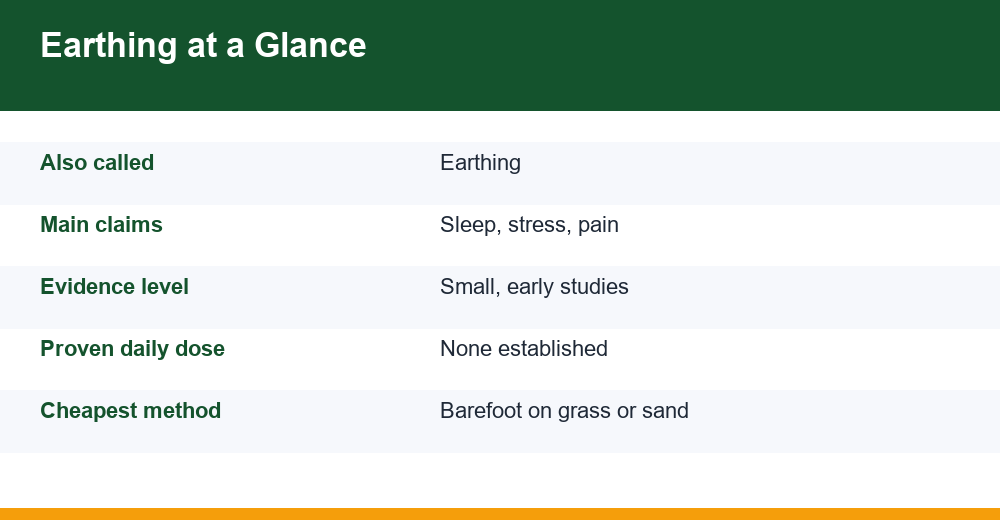
Grounding, also called earthing, means putting your skin in direct contact with the ground: standing barefoot on grass, walking on wet sand, sitting with your palms on soil, or wading in the sea. A commercial version uses mats, sheets or patches wired to the ground port of a wall outlet or to a rod pushed into the soil.
The core idea is electrical. The Earth’s surface carries a mild negative charge and a supply of free electrons. Proponents argue that modern life, with rubber soles and raised beds, cuts us off from that charge, and that reconnecting lets electrons flow into the body and neutralise excess positive charge linked, in their model, to inflammation.
That mechanism is a hypothesis, not settled physiology. It is worth separating two very different things that often get bundled together:
- The electrical claim: that contact with the ground measurably changes the body’s charge and, through that, inflammation, blood flow and stress hormones.
- The lifestyle reality: that time outside, barefoot and unhurried, is pleasant, calming and often comes with sunlight, movement and a break from screens.
The first is still debated. The second is hard to argue with, and it explains a lot of what people feel.
Grounding Benefits People Report: Sleep, Stress and Pain
Ask anyone who has made barefoot time a habit and you will hear similar stories. The most commonly reported grounding benefits cluster into three areas, and these are also the areas earthing researchers have studied most.
Sleep
People often say they fall asleep more easily and wake less in the night. One of the earliest studies, published by Ghaly and Teplitz in 2004, had 12 participants sleep on grounded pads and reported lower night-time cortisol and better self-rated sleep. It was a small pilot without a placebo group, so it can suggest a direction but not prove one.
Stress and mood
Many people describe feeling calmer, more settled and less wired after a session outside. Some early measurements found shifts in skin conductance and heart rate variability, which researchers read as a nudge toward the parasympathetic, rest-and-digest state. If that calm is what you are after, our guide to nervous system regulation covers other gentle tools that pair well with outdoor time.
Pain and recovery
Small pilot studies have looked at muscle soreness after hard exercise, with grounded groups reporting slightly less soreness. Others have reported changes in blood markers such as red blood cell clumping. These are intriguing signals from tiny samples, and they have not been confirmed by large independent trials.
The honest summary: the reports are real experiences, but the cause behind them is unclear. That is where the science comes in.
Is Grounding Backed by Science?
Partly, and weakly. There is a body of published earthing research, but most of it shares the same limitations: small sample sizes, short durations, few independent replications, and authors with ties to companies selling grounding products.
The most cited paper, a 2012 review by Chevalier and colleagues in the Journal of Environmental and Public Health, discloses that some of its authors were contractors for, and held shares in, a company that sponsors earthing research. That does not make the findings false, but it is a reason to wait for independent confirmation.
| Claim | What studies looked at | Main limitation |
|---|---|---|
| Better sleep | Grounded sleep pads; night-time cortisol and self-rated sleep (2004 pilot) | 12 people, no placebo group |
| Lower stress | Skin conductance and heart rate variability during sessions | Short sessions, small groups, mostly one research network |
| Less soreness after exercise | Grounded vs. sham-grounded recovery after hard workouts | Very small pilots; results not widely replicated |
| Thinner blood | Red blood cell charge and clumping after two hours grounded | Around ten participants, lab markers only |
| Sleep and mood in Alzheimer’s | 2022 double-blind pilot with sham grounding | 22 people; sleep improved, anxiety and depression scores did not |
Newer trials are starting to use sham mats, which look identical but are not connected to ground. That is the right design. So far, the results from these better-controlled studies have been mixed rather than dramatic, and the groups are still very small. The 2022 Alzheimer’s pilot is a good example: a sleep signal, no mood effect, and only 22 people.
Put plainly: grounding is a plausible but unproven practice. It is reasonable to call the evidence preliminary, and unreasonable to call it either proven or debunked.
Does Grounding Actually Work? The Placebo Question
If people feel better, does it matter why? For your own wellbeing, maybe not much. But it matters a lot when someone is selling you a product on the strength of electrons.
Several forces can make a practice feel effective even if the proposed mechanism does nothing:
- Expectation: believing a ritual will help changes how you rate sleep, pain and stress, especially on self-reported scales.
- Everything else that comes with it: being outside means daylight, fresh air, gentle movement and time away from your phone, each of which has its own effect on mood and sleep timing.
- Regression to the mean: people often start a new habit when they feel worst, and naturally feel better a few weeks later anyway.
- Attention: sitting still and noticing your feet on the grass is, in effect, a short mindfulness exercise.
Critics point out that many of the strongest-sounding results come from unblinded studies, where participants knew they were being grounded. Self-rated outcomes such as sleep quality, pain and mood are exactly the measures most open to expectation effects, which is why sham-controlled designs matter so much here.
None of this means you should not do it. It means the grounding benefits you notice may come mostly from the outdoor ritual itself, which is free, rather than from a special electrical effect that requires equipment.
Do Grounding Mats Work?
Grounding mats, sheets and pillowcases dominate search results for a simple reason: they can be sold. They plug into the ground pin of a wall socket and promise the outdoor effect while you sleep or work.
Whether they work depends on what you mean. Electrically, a properly connected mat does link your body to the building’s earth wiring. Whether that produces health effects is exactly the unproven part. Most mat studies are the same small, often industry-linked trials discussed above.
Practical concerns before buying
- Wiring: the mat relies on your outlet’s ground being correctly installed. Older or faulty wiring is a real issue, and an electrician is the person to check it.
- Electrical events: being connected to a building’s ground during a fault or storm is not the same as standing on a lawn. Follow the maker’s safety instructions and unplug during thunderstorms.
- Medications: even earthing proponents have cautioned that grounding might affect blood thinning in people on anticoagulants. If you take blood thinners, speak to your doctor first.
- Cost and clutter: these are another gadget, another cable and eventually another item in landfill.
If you are trying to own fewer things, the outdoor version is the more consistent choice. It fits naturally with a zero-waste home mindset: no packaging, no replacements, nothing to plug in.
Is Walking Barefoot on Grass Good for You?
For most healthy adults, yes, in moderation and with some common sense. Even setting the earthing theory aside, barefoot time outdoors has sensible upsides:
- Foot strength and feel: walking without shoes uses the small muscles of the feet and gives more sensory feedback from the ground.
- Time in nature: a 2019 study of nearly 20,000 people in England found that those who spent at least 120 minutes a week in nature were more likely to report good health and high wellbeing.
- Daylight: morning outdoor light helps anchor your body clock, which supports sleep timing.
- A pause: few people scroll their phone while carefully walking barefoot.
There are real risks too, and they are easy to manage. The CDC’s foot hygiene guidance lists hookworm and diabetes among the foot-related health concerns, and advises checking your feet regularly for cuts and sores. Hookworm larvae can enter through bare skin where soil is contaminated, and diabetes can damage nerves and blood flow in the feet.
| Situation | Barefoot outdoors? | Why |
|---|---|---|
| Healthy adult, clean lawn or beach | Generally fine | Low risk; check the ground first |
| Diabetes or reduced foot sensation | Avoid; ask your clinician | Small cuts can go unnoticed and get infected |
| Areas where hookworm is common | Avoid bare soil | Larvae can pass through the skin of the feet |
| Parks with dogs, broken glass or chemicals | Choose another spot | Puncture wounds, animal waste, pesticides |
| Hot pavement, sand at midday, frost | Skip or keep it brief | Burns and cold injury |
| Open cut or wound on the feet | Wait until healed | Infection risk, including tetanus |
If you step on something sharp, clean the wound well and get a deep puncture checked. Make sure your tetanus vaccination is up to date; adult boosters are generally recommended every ten years.
How Long Should You Ground Yourself Each Day?
There is no established daily dose. Studies have used anything from short sessions of under an hour to full nights on grounded sleep pads, and none was designed to find an ideal amount. Any specific number you see online, such as “30 minutes a day”, is a rule of thumb, not a research-backed prescription.
A practical way to think about it:
- Start small: 10 to 15 minutes, a few times a week, is easy to fit in and lets you notice whether you enjoy it.
- Build to what feels good: many people settle on 20 to 30 minutes on days when weather allows.
- Stack it: combine barefoot time with morning coffee, a stretch or a phone-free pause so it becomes a habit rather than a chore.
- Watch the weather: shorten sessions on cold ground, wet ground in winter, or hot sand.
If your real goal is better wellbeing from nature, the 120-minutes-a-week figure from the nature-exposure research is a more useful target than any earthing-specific number. That study found it made little difference whether the time came in one long visit or several shorter ones, so a few barefoot sessions in a park can count toward it.
A Simple, Free Way to Try It Safely
You do not need a mat, a subscription or a special app to find out whether you notice any grounding benefits yourself. Try this two-week experiment and judge it on how you actually feel.
- Pick a safe spot: your own lawn, a clean beach, or a quiet park corner you have checked for glass and dog waste.
- Go barefoot for 15 minutes: stand, walk slowly or sit with your feet flat on the grass or damp sand.
- Put the phone away: notice temperature, texture and your breath. This turns the session into an easy entry point to mindfulness practices.
- Keep a simple log: rate your sleep, stress and any aches from 1 to 10 each morning.
- Compare honestly: after two weeks, look at your notes. If you feel better, keep going. If nothing changes, you lost nothing but a few minutes in the fresh air.
A few final cautions. Earthing is not a treatment for any medical condition, and it should never replace care for chronic pain, insomnia, anxiety or inflammatory disease. Check with your clinician first if you have diabetes, poor circulation, neuropathy, open wounds or take blood thinners.
The most balanced view of grounding benefits is this: the electrical theory is unproven, the studies are small, and placebo likely plays a large part. Yet slow, barefoot minutes outside are cheap, pleasant and good for most people anyway. Enjoy them for what they are.
Frequently Asked Questions
Does grounding actually work?
Grounding seems to help some people feel calmer and sleep better, but it is unclear why. Most supportive studies are small, short and often linked to companies selling grounding products, and few use a sham control. Expectation, daylight and relaxation may do much of the work. It is low-risk to try, but unproven as a medical treatment.
What are the benefits of grounding?
People most often report better sleep, lower stress and less muscle soreness. Small studies have measured changes in cortisol, skin conductance and blood markers, but these have not been confirmed by large independent trials. The clearest benefits come from what grounding involves anyway: time in nature, daylight, gentle movement and a screen-free pause.
How long should you ground yourself each day?
No research has established an ideal daily amount. Studies have used sessions under an hour as well as overnight grounded pads. A sensible approach is to start with 10 to 15 minutes a few times a week and build to 20 to 30 minutes if you enjoy it, adjusting for weather, ground temperature and safety.
Is walking barefoot on grass good for you?
For most healthy adults, short barefoot walks on clean grass are safe and can strengthen the feet and add relaxing time outdoors. Check the ground for glass and animal waste, avoid soil where hookworm is common, and keep tetanus vaccination current. People with diabetes or reduced foot sensation should ask their clinician first.