Starting yoga for beginners at home is one of the gentlest, most flexible ways to build a movement habit, and you can begin today with nothing more than a little floor space and a few quiet minutes. This guide walks you through the styles worth trying, the one piece of kit you actually need, a handful of friendly poses, some simple breathing, and how to keep going once the novelty fades. Think of it as a calm starting point, not a fitness challenge.
Table of Contents
Why Yoga at Home Works for Beginners
Practising at home removes the two hurdles new starters mention most often: feeling self-conscious in a room full of bendy strangers, and finding time to travel to a studio. At home you set the pace, pause a video, dim the lights, and repeat the bits that feel awkward with nobody watching. That freedom makes it far easier to actually begin.
It helps to be honest about what the practice can and cannot do. Regular, gentle movement is linked with better flexibility, steadier balance, easier breathing and a lighter mood, and many people find it eases everyday stiffness and tension. It is a supportive lifestyle habit that complements a healthy life, not a treatment or cure for any medical condition.
One reason yoga for beginners suits home practice so well is that the early stages are really about learning to notice your body, not performing impressive shapes. There is nothing to keep up with and nobody to compare yourself to, which is exactly the mindset that helps a new habit take root.
Home practice also folds neatly into the rest of your day. A few slow stretches after waking pair naturally with a wider morning routine for wellness, while a calming sequence in the evening can help you put the day down before sleep.
There is a social side too, which home practice need not lose. Once you feel comfortable, a live online class or a local beginners group can add gentle guidance and a sense of routine, without the pressure of an advanced room.
Choosing a Beginner-Friendly Style
The word yoga covers dozens of styles, and some are far kinder to newcomers than others. A common early mistake is leaping into a fast, sweaty flow before the basic postures feel familiar, which is often where strain and frustration creep in.
For most people starting out, a slower style makes the poses easier to learn and the whole experience more enjoyable. Hot styles such as Bikram add heat and intensity that beginners rarely need at first. Here is how the popular options compare.
| Style | Pace | Good for beginners? | What to expect |
|---|---|---|---|
| Hatha | Gentle to moderate | Excellent | Poses held long enough to learn alignment |
| Restorative | Very slow | Excellent | Fully supported, relaxing, props do the work |
| Iyengar | Slow to moderate | Excellent | Precise alignment with plenty of prop support |
| Yin | Slow | Good | Long, passive holds targeting deeper tissue |
| Vinyasa | Faster flow | Later on | Poses linked to breath; easier once basics feel natural |
| Chair yoga | Gentle | Excellent | Seated or supported; ideal for limited mobility |
If you are unsure, begin with Hatha, Iyengar or restorative sessions, then add a flowing style once holding the basic shapes feels natural. There is no prize for rushing the process.
How to sample a style for free
You do not have to commit to anything to explore. Search for beginner Hatha or restorative sessions on free video platforms, pick a teacher whose voice you find calming, and try a ten-minute class. If it leaves you feeling better rather than defeated, you have probably found a good place to begin.
What You Need to Start (Just a Mat)
The good news for anyone exploring yoga for beginners is that the barrier to entry is remarkably low. The wellness industry would happily sell you a wardrobe of gear, but the honest answer is that you need very little to make a real start.
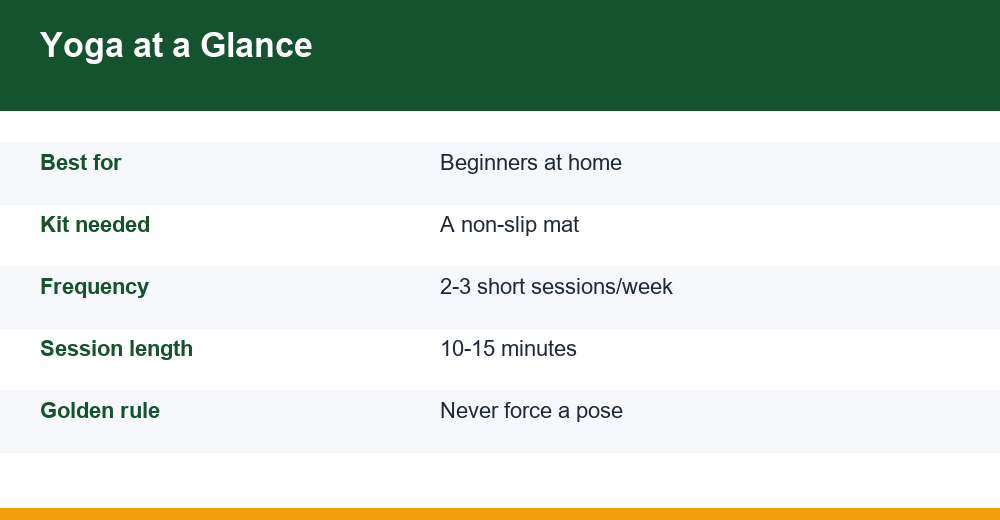
A single non-slip mat is the one purchase worth making. A stable, cushioned surface protects your wrists in poses like downward dog and stops your feet sliding during standing shapes. A mat around four to six millimetres thick suits most people; thicker mats feel plush but can wobble in balancing poses.
- A grippy yoga mat, ideally four to six millimetres thick
- Comfortable clothes you can stretch and breathe in
- A folded blanket or firm cushion to sit on
- A couple of books or foam blocks to bring the floor closer
- A bottle of water and a small towel within reach
A word on flooring
On a hard floor, a mat or folded blanket protects your knees and spine in kneeling and lying poses. On thick carpet you may want a firmer surface for balance. Small adjustments like these make the difference between a practice that feels good and one that nags at your joints.
You do not need a heated room, designer leggings or a particular body type. Bare feet grip best, a rug can stand in for a mat at first, and a quiet corner where you will not be interrupted matters more than any accessory you could buy. Wiping the mat down after use and letting it air keeps it grippy and fresh for the next session.
Simple Poses in Yoga for Beginners
These foundational poses appear in almost every class and give you a rounded taste of standing, seated and resting shapes. Move into each one slowly, keep breathing, and back off the moment you feel anything sharp or pinching rather than a gentle stretch.
- Mountain pose (Tadasana): Stand tall with feet hip-width apart and arms relaxed. It quietly teaches posture, grounding and steady breathing.
- Cat-cow: On hands and knees, alternate arching and rounding your spine in time with your breath to loosen the whole back.
- Downward-facing dog: An inverted V shape that stretches the back of the body; bend your knees generously while you learn it.
- Child’s pose (Balasana): A folded kneeling rest you can return to at any moment you need a pause.
- Cobra: A gentle backbend from lying face down, lifting your chest only as far as feels comfortable.
- Seated forward fold: Sit with your legs long and hinge forward from the hips, reaching without straining.
- Corpse pose (Savasana): Lie flat and completely still for a few minutes to let everything settle at the end.
Listen to your body, not the screen
A video instructor cannot see you, so you are your own safety check. If a teacher’s version of a pose does not suit your body today, take the gentler option shown or invent your own. Ranges of motion vary hugely between people, and none of this is a competition.
Feel free to modify. Bend your knees, rest your hands on blocks, or drop to the floor whenever a pose feels like too much. Five poses done with real attention will serve you better than twenty rushed ones.
A Short 15-Minute Starter Sequence
Once the individual shapes feel familiar, stringing them together turns them into a practice. This gentle sequence takes roughly fifteen minutes and asks nothing you have not already met above. Keep your breath slow and let it lead the movement.
- Sit comfortably and take ten slow breaths to arrive (about two minutes).
- Move through cat-cow for a minute to wake up the spine.
- Step back into downward dog, pedalling the feet, for a minute.
- Flow to child’s pose and rest there for a few breaths.
- Rise to mountain pose and sweep the arms overhead a few times.
- Lower down for cobra twice, resting your forehead between lifts.
- Settle into a seated forward fold for about a minute.
- Finish in corpse pose for three to five quiet minutes.
Repeat the middle poses if you have more time, or trim the sequence to the parts you enjoy on a busy day. The best routine is the one you will genuinely come back to, so a short practice you actually do always beats a long one you skip.
Breathing: The Quiet Engine of Your Practice
If the poses are the visible part of yoga, breathing is the engine underneath. Slow, steady breath through the nose helps you stay present, can help your nervous system settle, and stops you rushing from one shape to the next.
Try a simple pattern: inhale for a count of four, then exhale for a count of six, letting your belly soften as you go. Many people find a slightly longer exhale helps them feel calmer. Never strain or hold your breath to the point of discomfort, and if you ever feel dizzy, return to normal, easy breathing.
The most common mistake is unconsciously holding the breath during effort. Instead, keep it flowing, and let a challenging pose remind you to breathe rather than clench.
This overlap is exactly why breathwork and mindfulness sit so close together. If you are drawn to the calmer side of practice, a short session of meditation for beginners is a natural companion that builds the same quality of steady, unforced attention.
Staying Safe: Move Gently, Never Force
Yoga has a gentle reputation, and serious injuries are uncommon, but they do happen, usually from overstretching or repeating a movement past the point of comfort. The rule to remember is simple: a mild stretching sensation is fine, while sharp, pinching or radiating pain is a clear signal to stop.
- Warm up with gentle movement rather than dropping straight into deep stretches.
- Never force a pose to match a photo; always work within your own range.
- Use blocks and cushions freely, they are a sign of smart practice, not weakness.
- Come out of any pose that causes numbness, tingling or sharp pain.
- Rest whenever you need to; child’s pose is always available.
Some situations call for extra care. If you are pregnant, recovering from surgery or an injury, or living with a condition such as high blood pressure, a heart problem or a back issue, speak to a doctor before you start and seek a teacher trained for your circumstances. Pregnant beginners are generally advised to avoid hot styles, deep abdominal work and lying flat on the back later in pregnancy, and to practise with a qualified prenatal instructor.
Children, older adults and anyone returning to movement after a long break also do best with a gentler, tailored start. For young children in particular, a short, playful and supervised approach suits them far better than an adult class, and a specialist teacher can pitch the poses at the right level.
For a reliable overview and free follow-along routines, the NHS guide to yoga and Pilates is a trustworthy place to begin. This article is general information for healthy adults and not medical advice, so please consult a qualified professional about any pain, symptom, pregnancy or ongoing health concern.
What to Expect in Your First Few Weeks
The early weeks of any new practice can feel a little clumsy, and that is completely normal. Poses that look simple on screen may feel unfamiliar in your own body, your balance may wobble, and you might notice muscles you had forgotten you owned. None of this means you are doing it wrong; it means you are learning.
Mild stiffness a day after practice is common when you first begin, much as it is with any new movement, and it usually eases as your body adapts over a week or two. Sharp pain, swelling or discomfort that lingers is different, and a signal to rest and check in with a professional rather than push on.
Progress here is rarely dramatic, which is part of the charm. Rather than watching only for deeper stretches, notice the quieter shifts: steadier balance, easier breathing, and a calmer few minutes at the end of a session. These small wins are the ones that keep people coming back long after the first burst of enthusiasm.
Building a Habit That Lasts
The people who feel the benefits of yoga are rarely the most flexible; they are the ones who keep showing up. Consistency matters far more than intensity, particularly in the first few months when the habit is still fragile.
Aim for two or three short sessions a week rather than one heroic hour, and let the habit grow from there if it feels right. Ten focused minutes most days is more sustainable, and often more useful, than an ambitious schedule you quietly abandon after a fortnight.
- Pick a regular time, such as first thing in the morning or before bed.
- Keep your mat somewhere visible so it acts as a reminder.
- Tick off each session on a calendar to watch the habit build.
- Pair practice with something you already do, like your morning coffee.
- Forgive missed days and simply begin again, without guilt.
Expect your motivation to dip, because everyone’s does. When it happens, shrink the session rather than skipping it entirely: even five minutes on the mat keeps the thread unbroken. Miss a day, forgive it, and start again the next.
Approached this way, yoga for beginners stops feeling like a project and becomes a small, dependable part of how you care for yourself. Start slow, stay curious, and let the practice unfold at its own quiet pace.
Frequently Asked Questions
Is yoga safe for beginners to do at home?
For most healthy adults, yes. Move gently, avoid forcing any pose, and stop if you feel sharp pain. If you are pregnant, injured or managing a health condition, check with a doctor first and consider a qualified teacher to guide your early sessions.
How often should a beginner practise yoga?
Two or three short sessions a week is a realistic starting point, and you can build up gradually if it suits you. Consistency beats length, so ten steady minutes most days will usually do more for you than one occasional marathon session.
Do I need to be flexible to start?
Not at all. Flexibility is a result of practising, not a requirement for it. Yoga meets you where you are, and props like blocks and cushions make poses more accessible. Working within your own range is the whole point, not touching your toes on day one.
Which yoga style should a complete beginner choose?
Gentler styles such as Hatha, Iyengar, restorative or chair yoga are the easiest to learn from, because poses are held long enough to understand them. Faster flowing styles like Vinyasa become more rewarding once the basic postures already feel comfortable in your body.